
Not many organisations in the region have tested whether their people can spot OT security problems, decide what to do, and get production back safely. Yokogawa’s newly-launched Industrial Cyber Resilience Center (ICRC) aims to build organisational cyber readiness and capability development training for fast and safe recovery.
The integration of AI in exploit development represents a qualitative change in the offensive AI threat landscape, with implications for defense strategies and operational capabilities.
Recent research highlights the urgent need for enhanced cybersecurity measures to protect industrial devices from evolving threats.
Some cybersecurity researchers tested whether AI can successfully adapt a remote code execution (RCE) exploit developed for one programmable logic controller (PLC) so that it works against another.
By using AI to help port an existing RCE exploit between two PLC models, the experiment was ultimately successful, demonstrating that AI can assist with highly specialised exploit development in embedded environments.
Permanently disabled. No reboot, no reinstall. That is a red alert…
Organisations, especially critical infrastructure operators, need to consider what happens when increasingly autonomous AI-powered exploit development meets the large number of exposed industrial devices – and the technological barriers protecting them begin to disappear.
The OT-IT cyberthreat landscape
The cybersecurity threat landscape is evolving rapidly as AI continues to accelerate both cyber-attack and cyber defence capabilities. Cyber adversaries are increasingly leveraging automation and AI to identify vulnerabilities, improve deception techniques, and conduct attacks at greater speed and scale.
At the same time, the convergence of information technology (IT) and operational technology (OT) environments is creating new cybersecurity challenges. Many industrial organisations continue to operate legacy systems and rely on IT-centric response playbooks that were not designed to address the safety, availability, and operational continuity requirements of OT systems.
While many organisations have invested in preventive cybersecurity technologies, fewer have established and regularly tested their ability to respond to and recover from cyber incidents.
Unlike IT, OT cyber incidents require key decision-making that takes into consideration safety, production continuity, and asset integrity. Leveraging its deep expertise in IT/OT convergence, Yokogawa is looking to enable customers to assess operational readiness, validate response plans, and improve stakeholder coordination under realistic cyber drill scenarios.
Cyber resilience training, services and solutions
To that end, Yokogawa Engineering Asia has launched the Industrial Cyber Resilience Center (ICRC) in Singapore as a regional hub for Southeast Asia, Oceania, and Taiwan, offering a comprehensive portfolio of cybersecurity training, solutions, and services designed to help organisations identify capability gaps, strengthen cyber resilience, and enhance their ability to respond to and recover safely and efficiently from cyber incidents.
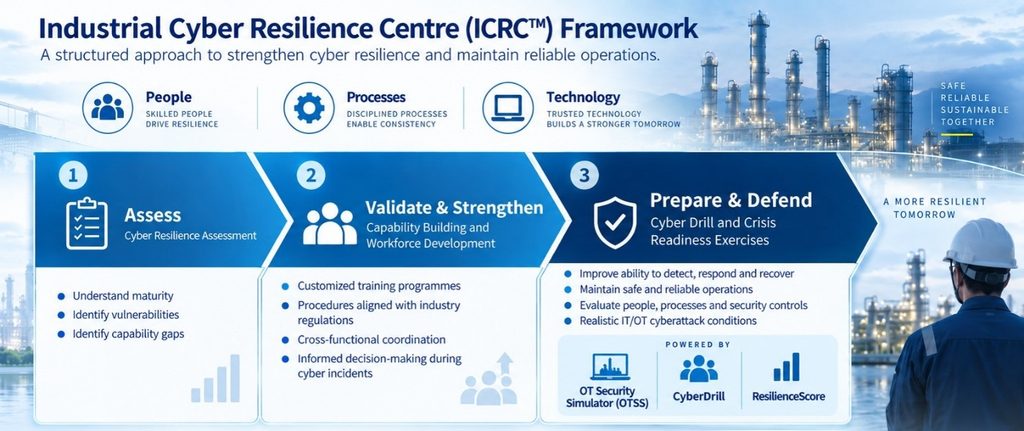
ICRC framework to strengthen cyber resilience and maintain reliable operations.
The ICRC provides a structured framework that helps organisations develop the right combination of people, processes, and technology required to strengthen cyber resilience and maintain reliable operations:
1. Assess: Cyber Resilience Assessment
Assess to understand maturity, vulnerabilities, and capability gaps.
2. Validate and Strengthen: Capability Building and Workforce Development
Develop workforce competencies through customised training programmes, establish procedures aligned with industry regulations, and enhance cross-functional coordination to support informed and effective decision-making during cyber incidents.
3. Prepare and Defend: Cyber Drill and Crisis Readiness Exercises
Strengthen cyber resilience by improving the organisation’s ability to detect, respond to, and recover from cyber incidents, while maintaining safe and reliable operations, using Yokogawa’s OT Security Simulator, Cyber drill exercises, and ResilienceScore solutions.
OT-IT cyber readiness in the AI era
The exponential rate of agentic AI adoption – and the looming challenge of quantum AI – is heightening the sense of urgency among cyber defenders of critical infrastructure operators in Southeast Asia.
“With the launch of the ICRC, Yokogawa is reinforcing its commitment to helping customers navigate an increasingly complex cybersecurity landscape,” said Chay Kin Wah, President and CEO, Yokogawa Engineering Asia.
“Through the center, we are investing in both advanced capabilities and workforce development to strengthen resilience across IT and OT environments. Our goal is to help organisations build cyber resilience, enabling them to operate securely and innovate with confidence.”
Charles Lim, Head of Digital Security Solution, Yokogawa Engineering Asia, added: “A key challenge for many organisations is not the lack of cybersecurity technologies, but the ability to recognise abnormal situations, respond effectively, and recover quickly from an incident.
“What makes the ICRC unique is its ability to validate organisations’ preparedness by testing people, processes, and security controls under realistic cyber-physical conditions. As cyber resilience extends beyond a single organisation, the ICRC also helps strengthen coordination across stakeholders, supply chains, and interconnected operational networks.”
For more information, please refer to Yokogawa’s cybersecurity program: Security Program | Yokogawa SE Asia