


Cybersecurity News in Asia

RECENT STORIES:

SEGA moves faster with flow-based network monitoring
LRQA Named ‘Best in Critical Infrastructure Protection’ at...
Ransomware group alleges attack and exfiltration of data linked to maj...
Japan’s Digital Agency announces: VPN flaw exposed 246,000 records
Cyble and Cyber Security Council of UAE Sign MOU to Strengthen Nationa...
Multi-agent AI systems may unpredictably bypass safety controls, study...
LOGIN REGISTER
CybersecAsia
  • Features
    • Featured

      Addressing the AI-driven vulnerability debt

      Addressing the AI-driven vulnerability debt

      Thursday, September 17, 2026, 10:03 AM Asia/Singapore | Features, Sponsored
    • Featured

      Cybercriminals zero In on APAC’s digital boom, SMBs in the crosshairs

      Cybercriminals zero In on APAC’s digital boom, SMBs in the crosshairs

      Wednesday, September 16, 2026, 2:30 PM Asia/Singapore | Features, Sponsored
    • Featured

      The recovery-first approach to data resilience

      The recovery-first approach to data resilience

      Monday, September 7, 2026, 4:21 PM Asia/Singapore | Features
  • Opinions
  • Tips
  • Whitepapers
  • AWARDS 2026
  • Directory
  • E-Learning

Select Page

News

Scammers abuse popular collaboration tools to send phishing emails

By CybersecAsia editors | Tuesday, January 27, 2026, 11:50 AM Asia/Singapore

Scammers abuse popular collaboration tools to send phishing emails

Attackers exploit organization name and team invite features to deliver vishing and spam from trusted domains.

Cybercriminals have found a new way to abuse OpenAI’s collaboration features to send scam messages that appear to come from legitimate company addresses.

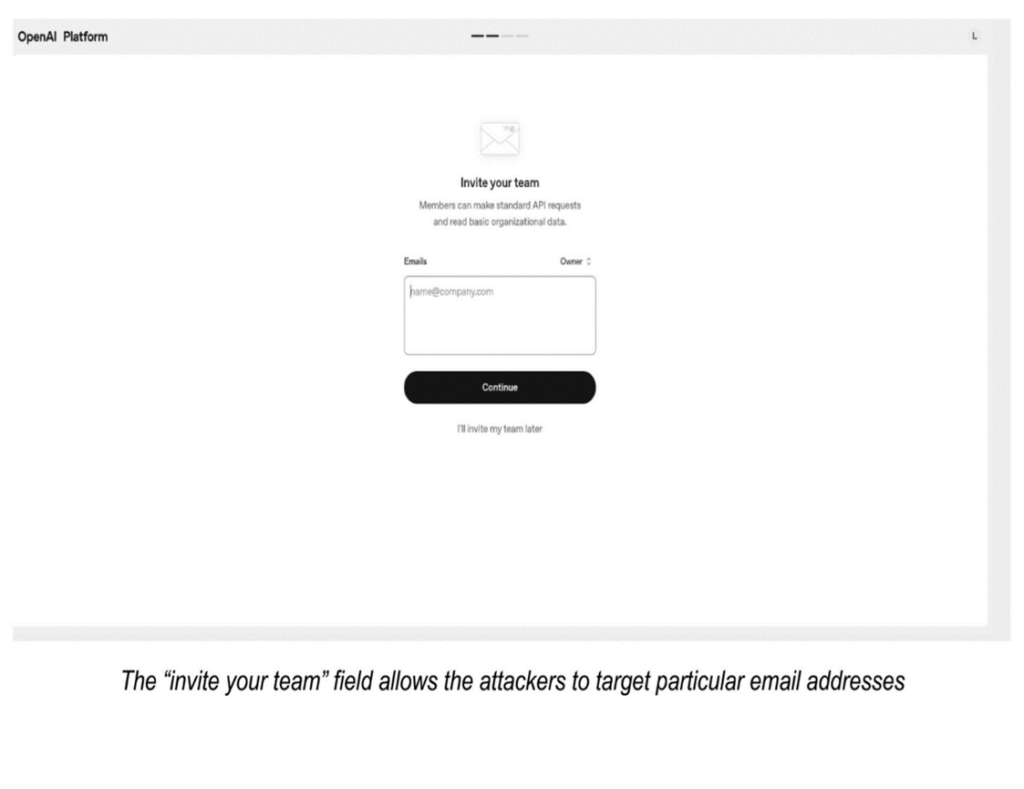
According to findings by Kaspersky analysts, attackers are using OpenAI’s “organization creation” and “invite your team” functions — both intended for internal use — to send spam and phishing emails through official OpenAI mail servers. This makes the messages technically authentic at first glance, bypassing some common email filters.

The scheme relies on the ability to name an “organization” during setup with any string of text or symbols. Attackers fill that field with deceptive wording, links, or phone numbers, which then appear in the body of the invitation email. After creating the organization, they use the “invite your team” option to target specific email addresses, delivering their fraudulent content from a legitimate OpenAI domain.

Variations on a theme
Researchers have observed several variations of this attack. Some emails promote adult websites or dubious services, while others impersonate billing notifications, claiming a subscription has been renewed for a large sum. Recipients are then urged to call a phone number to dispute the charge — a common vishing technique used to extract payment or personal information.

This form of abuse highlights a broader security concern: everyday platform features can be weaponized for social engineering. By inserting malicious text into fields not traditionally associated with content distribution, scammers can sidestep conventional detection systems and exploit users’ trust in reputable brands.

Hardening defenses against this attack
According to the Kaspersky security team, organizations need to:

  • Treat unsolicited invitations from any platform with suspicion, even if appearing to originate from trusted sources
  • Carefully inspect clickable URLs for suspicious domains before launching any link
  • Avoid calling any phone numbers indicated in suspicious emails — it is best to find the phone number on the official webpage of this service, and use that number to initiate contact
  • Report suspicious emails to the platform provider and use multi-factor authentication for all accounts
  • Install multi-layered email defense solutions that provide robust protection against a wide range of evolving threats and offering anti-phishing features designed to help intervene in phishing attacks and improve overall cybersecurity

For organizations, implementing multi-factor authentication and security tools that monitor outbound and inbound messages for anomalies can further reduce risk.

Share:

PreviousThe State of PKI Security in 2026
NextRethinking customer identity for financial cybersecurity

Related Posts

Bridging India’s digitalization divide: cybersecurity startups

Bridging India’s digitalization divide: cybersecurity startups

Thursday, April 20, 2023

Do corporations know the various AI risks that come with insufficient data security preparedness?

Do corporations know the various AI risks that come with insufficient data security preparedness?

Wednesday, August 6, 2025

When CISOs and senior management are not aligned, try these techniques

When CISOs and senior management are not aligned, try these techniques

Friday, March 13, 2020

Did APAC experience the most online fraud on social media/app platforms in Q1?

Did APAC experience the most online fraud on social media/app platforms in Q1?

Thursday, June 23, 2022

Leave a reply Cancel reply

You must be logged in to post a comment.

Voters-draw/RCA-Sponsors

Slide
Slide
Slide
Slide
Slide
Slide
Slide
Slide
Slide
Slide
Slide
Slide
Slide
Slide
Slide
Slide
Slide
Slide
Slide
previous arrow
next arrow

CybersecAsia Voting Placement

Gamification listing or Participate Now

LEARN MORE

Vote Now -Placement(Google Ads)

Top-Sidebar-banner

Whitepapers

  • Critical Security Threatsand the Need for ZTNA: How evolving cyberattacks demand a Zero Trust approach

    Critical Security Threatsand the Need for ZTNA: How evolving cyberattacks demand a Zero Trust approach

    Cyber threats have become more frequent and sophisticated, targeting organizations of all sizes across all …Download Whitepaper
  • Zero Trust Made Simple: Why it matters and how to get started

    Zero Trust Made Simple: Why it matters and how to get started

    Data breaches and cyberattacks are no longer limited to large, high-profile organizations.Download Whitepaper
  • Cloud Secure Edge: Remote access, better security

    Cloud Secure Edge: Remote access, better security

    ​SonicWall Cloud Secure Edge™ is a modern, cloud-native Security Service Edge (SSE) solution that addresses …Download Whitepaper
  • Closing the Gap in Email Security:How To Stop The 7 Most SinisterAI-Powered Phishing Threats

    Closing the Gap in Email Security:How To Stop The 7 Most SinisterAI-Powered Phishing Threats

    Insider threats continue to be a major cybersecurity risk in 2024. Explore more insights on …Download Whitepaper

Middle-sidebar-banner

Case Studies

  • How a Vietnamese D2C retailer built its own secure digital infrastructure

    How a Vietnamese D2C retailer built its own secure digital infrastructure

    Would your organization build your own digital infrastructure – including AI governance and cybersecurity – …Read more
  • Cyber protection for medical clinics in Singapore

    Cyber protection for medical clinics in Singapore

    As Singapore’s healthcare sector becomes increasingly digital and interconnected, clinics are facing heightened cyber risks, …Read more
  • India’s WazirX strengthens governance and digital asset security

    India’s WazirX strengthens governance and digital asset security

    Revamping its custody infrastructure using multi‑party computation tools has improved operational resilience and institutional‑grade safeguardsRead more
  • Bangladesh LGED modernizes communication while addressing data security concerns

    Bangladesh LGED modernizes communication while addressing data security concerns

    To meet emerging data localization/privacy regulations, the government engineering agency deploys a secure, unified digital …Read more

Bottom sidebar

Other News

  • LRQA Named ‘Best in Critical Infrastructure Protection’ at CybersecAsia Readers’ Choice Awards 2026

    Monday, September 21, 2026
    Prestigious regional recognition highlights LRQA’s …Read More »
  • Cyble and Cyber Security Council of UAE Sign MOU to Strengthen National Threat Intelligence Capabilities

    Thursday, September 17, 2026
    ABU DHABI, UAE, Sept. 17, …Read More »
  • Cohesity Research Finds Most Cyber Recovery Plans Are Built for the Wrong Outcome

    Thursday, September 17, 2026
    78% organizations prioritize restoring systems …Read More »
  • SU Group Secures Exclusive Distribution Rights for Portable X-Ray System in Hong Kong and Macau

    Tuesday, September 15, 2026
    Second International Distribution Deal of …Read More »
  • SU Group Holdings Limited Announces Proposed Acquisition of KM Safety Solution Company Limited

    Tuesday, September 15, 2026
    HONG KONG, Sept. 15, 2026 …Read More »
  • Our Brands
  • DigiconAsia
  • MartechAsia
  • Home
  • About Us
  • Contact Us
  • Sitemap
  • Privacy & Cookies
  • Terms of Use
  • Advertising & Reprint Policy
  • Media Kit
  • Subscribe
  • Manage Subscriptions
  • Newsletter

Copyright © 2026 CybersecAsia All Rights Reserved.