Cybersecurity News in Asia

RECENT STORIES:

SEGA moves faster with flow-based network monitoring
Tencent Cloud Cube Sandbox Goes Fully Open-Source, with Five Major Bre...
We buckle seatbelts instinctively: why not authentication standards?
Sparrow to Demonstrate AI-Driven Security and SBOM Management at Black...
Relativity to Establish Singapore Entity, Expanding APAC Footprint
Cohesity Appoints Nigel Lee as Technical Sales Leader, Asia Pacific an...
LOGIN REGISTER
CybersecAsia
  • Features
    • Featured

      How AI is supercharging insider threats

      How AI is supercharging insider threats

      Wednesday, April 15, 2026, 12:29 PM Asia/Singapore | Features
    • Featured

      Q-Day is coming. Are you ready?

      Q-Day is coming. Are you ready?

      Tuesday, April 14, 2026, 12:40 PM Asia/Singapore | Features
    • Featured

      How lean defence teams turn endpoint insights into measurable risk reduction

      How lean defence teams turn endpoint insights into measurable risk reduction

      Monday, April 13, 2026, 3:15 PM Asia/Singapore | Features
  • Opinions
  • Tips
  • Whitepapers
  • Awards 2025
  • Directory
  • E-Learning

Select Page

Opinions

We buckle seatbelts instinctively: why not authentication standards?

By ernesto Alagos | Thursday, April 23, 2026, 4:01 PM Asia/Singapore

We buckle seatbelts instinctively: why not authentication standards?

This writer provides a primer arguing for authentication standards mandates like seatbelts/airbags against increasingly sophisticated phishing, credential theft.

It is hard to believe this now, but there was a time when automobiles did not come with now-ubiquitous three-point seatbelts. The change happened in 1959 when the technology was made freely available for other manufacturers to use. This commercial decision, alongside airbags, would go on to save millions of lives.

Similarly, the digital world should now offer a seatbelt-like buffer: Identity theft, data breaches, and infrastructure compromises continue to pose persistent risks. Phishing attacks, increasingly aided by AI, are growing more sophisticated. Beyond authentication methods, there is a need for security standards that are widely accessible, simple to use, and embedded in the infrastructure people depend on.

Like seatbelts, digital security only works if it works broadly. Yet despite this awareness, many organizations still rely on authentication methods designed for a different era.

Two major threat landscape vectors

Credential-based attacks are accelerating, and account takeover attacks also increased globally last year, according to some official estimates.

Next, phishing attacks have become faster, more targeted, and easier to scale. Attackers can automate campaigns and tailor messages using publicly available information, generating convincing phishing emails with minimal effort.

Alongside these changes, some underlying issues persist. Many organizations continue to depend on authentication methods that remain susceptible to phishing and exploitation. While SMS- or app-based multi-factor authentication (MFA) adds a layer of protection, these approaches still rely on shared secrets.

Shared secrets can be compromised if users are tricked into revealing them, making them vulnerable in phishing scenarios.

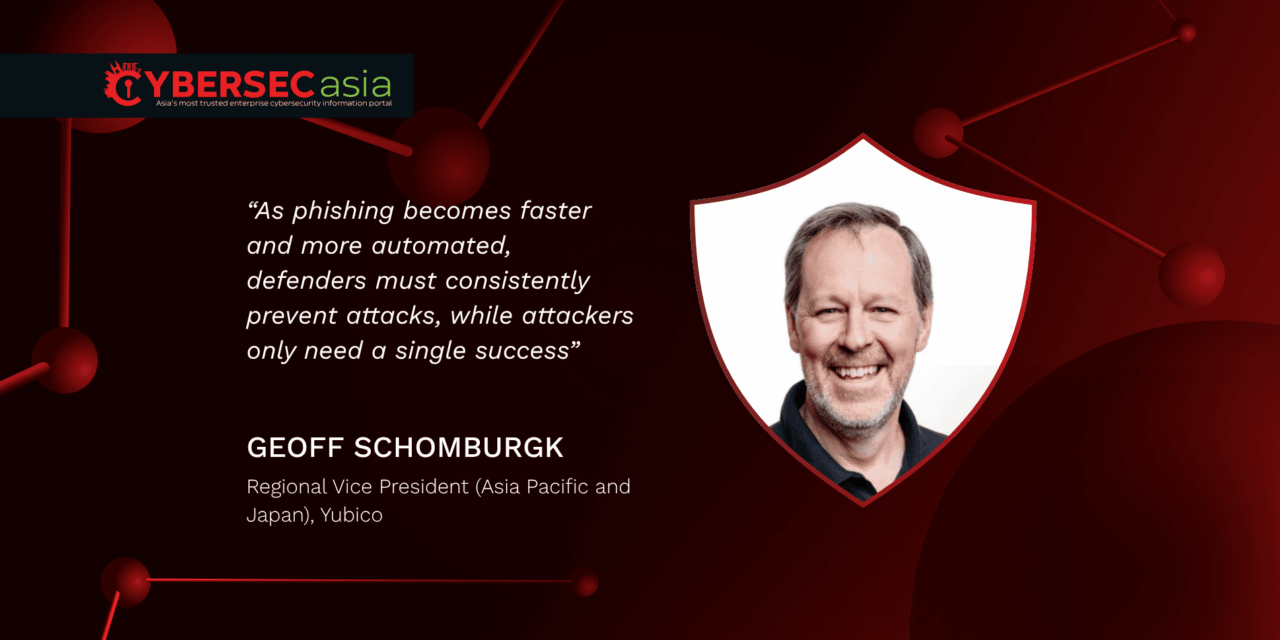
Traditional training also struggles to keep pace with evolving attacks. As phishing becomes faster and more automated, defenders must consistently prevent attacks, while attackers only need a single success.

Moving beyond shared secrets

With attackers generating large volumes of phishing emails, harvesting credentials in real time, and automating login attempts, passwords alone are increasingly insufficient.

One alternative removes shared secrets using platform or device-based cryptography aligned with standards aligned with standards such as FIDO2, WebAuthn and CTAP2. These standards use public-key cryptography where a private key stays securely stored on the user’s device (via CTAP2), while the corresponding public key is registered with the service (via WebAuthn).

During login, the service sends a cryptographic challenge that only the registered device can sign and return. Because the private key never leaves the device, it cannot be phished or remotely extracted.

Large-scale deployments of phishing-resistant authentication have shown strong results in reducing account compromise. However, beyond security, such approaches can also improve usability. Some implementations work offline and in smart-device-restricted environments. Broader adoption requires industry interoperability around open standards and interoperability across platforms and devices.

The seatbelt became ubiquitous because it was simple, effective, and widely adopted. Digital security now requires a similar approach: not fragmented solutions — but broadly accessible protections that can be implemented at scale. Security protects what matters most when implemented where risk is highest.


Share:

PreviousSparrow to Demonstrate AI-Driven Security and SBOM Management at Black Hat Asia 2026
NextTencent Cloud Cube Sandbox Goes Fully Open-Source, with Five Major Breakthroughs Enabling Large-Scale Agent Deployment

Related Posts

The logistics industry is always in the crosshairs of cybercriminals. Why?

The logistics industry is always in the crosshairs of cybercriminals. Why?

Tuesday, July 30, 2024

Japan’s PIPA prompts car maker to adopt secure identity management

Japan’s PIPA prompts car maker to adopt secure identity management

Wednesday, November 18, 2020

Building trust in a world of AI and quantum technologies

Building trust in a world of AI and quantum technologies

Monday, June 12, 2023

South Korean firm’s November massive data breach hits a legal ramification

South Korean firm’s November massive data breach hits a legal ramification

Monday, December 8, 2025

Leave a reply Cancel reply

You must be logged in to post a comment.

Voters-draw/RCA-Sponsors

Slide
Slide
Slide
Slide
Slide
Slide
Slide
Slide
Slide
Slide
Slide
Slide
Slide
Slide
previous arrow
next arrow

CybersecAsia Voting Placement

Gamification listing or Participate Now

PARTICIPATE NOW

Vote Now -Placement(Google Ads)

Top-Sidebar-banner

Whitepapers

  • Closing the Gap in Email Security:How To Stop The 7 Most SinisterAI-Powered Phishing Threats

    Closing the Gap in Email Security:How To Stop The 7 Most SinisterAI-Powered Phishing Threats

    Insider threats continue to be a major cybersecurity risk in 2024. Explore more insights on …Download Whitepaper
  • 2024 Insider Threat Report: Trends, Challenges, and Solutions

    2024 Insider Threat Report: Trends, Challenges, and Solutions

    Insider threats continue to be a major cybersecurity risk in 2024. Explore more insights on …Download Whitepaper
  • AI-Powered Cyber Ops: Redefining Cloud Security for 2025

    AI-Powered Cyber Ops: Redefining Cloud Security for 2025

    The future of cybersecurity is a perfect storm: AI-driven attacks, cloud expansion, and the convergence …Download Whitepaper
  • Data Management in the Age of Cloud and AI

    Data Management in the Age of Cloud and AI

    In today’s Asia Pacific business environment, organizations are leaning on hybrid multi-cloud infrastructures and advanced …Download Whitepaper

Middle-sidebar-banner

Case Studies

  • Cyber protection for medical clinics in Singapore

    Cyber protection for medical clinics in Singapore

    As Singapore’s healthcare sector becomes increasingly digital and interconnected, clinics are facing heightened cyber risks, …Read more
  • India’s WazirX strengthens governance and digital asset security

    India’s WazirX strengthens governance and digital asset security

    Revamping its custody infrastructure using multi‑party computation tools has improved operational resilience and institutional‑grade safeguardsRead more
  • Bangladesh LGED modernizes communication while addressing data security concerns

    Bangladesh LGED modernizes communication while addressing data security concerns

    To meet emerging data localization/privacy regulations, the government engineering agency deploys a secure, unified digital …Read more
  • What AI worries keep members of the Association of Certified Fraud Examiners sleepless?

    What AI worries keep members of the Association of Certified Fraud Examiners sleepless?

    This case study examines how many anti-fraud professionals reported feeling underprepared to counter rising AI-driven …Read more

Bottom sidebar

Other News

  • Tencent Cloud Cube Sandbox Goes Fully Open-Source, with Five Major Breakthroughs Enabling Large-Scale Agent Deployment

    Thursday, April 23, 2026
    Tencent Cloud’s Cube Sandbox goes …Read More »
  • Sparrow to Demonstrate AI-Driven Security and SBOM Management at Black Hat Asia 2026

    Wednesday, April 22, 2026
    SINGAPORE, April 21, 2026 /PRNewswire/ …Read More »
  • Relativity to Establish Singapore Entity, Expanding APAC Footprint

    Wednesday, April 22, 2026
    News Summary:  Relativity plans to …Read More »
  • Cohesity Appoints Nigel Lee as Technical Sales Leader, Asia Pacific and Japan (APJ)

    Wednesday, April 22, 2026
    SINGAPORE, April 21, 2026 /PRNewswire/ …Read More »
  • Akuvox Launches AKClaw Panel: The World’s First Indoor Monitor Optimized for Native OpenClaw™ Execution

    Tuesday, April 21, 2026
    XIAMEN, China, April 21, 2026 …Read More »
  • Our Brands
  • DigiconAsia
  • MartechAsia
  • Home
  • About Us
  • Contact Us
  • Sitemap
  • Privacy & Cookies
  • Terms of Use
  • Advertising & Reprint Policy
  • Media Kit
  • Subscribe
  • Manage Subscriptions
  • Newsletter

Copyright © 2026 CybersecAsia All Rights Reserved.