Cybersecurity News in Asia

RECENT STORIES:

SEGA moves faster with flow-based network monitoring
How the financial services sector struggles with AI maturity despite d...
Digital Identity Co. Modernizes Thailand Immigration Bureau Services w...
VIVOTEK VORTEX Powers AI Cloud Security in Denmark’s Kongens Ege...
DJI Releases Findings of the Most Comprehensive Independent Security A...
Ransomware activity stays high, new threat groups emerge
LOGIN REGISTER
CybersecAsia
  • Features
    • Featured

      Hidden trade-offs behind enterprise AI ambitions

      Hidden trade-offs behind enterprise AI ambitions

      Tuesday, May 26, 2026, 10:16 AM Asia/Singapore | Features
    • Featured

      Is secure issuance a solved problem, or is the debate more complex?

      Is secure issuance a solved problem, or is the debate more complex?

      Thursday, May 21, 2026, 3:11 PM Asia/Singapore | Features
    • Featured

      Cyber risk, fraud, and CX: Why banks can’t treat them separately anymore

      Cyber risk, fraud, and CX: Why banks can’t treat them separately anymore

      Wednesday, May 20, 2026, 9:34 AM Asia/Singapore | Features
  • Opinions
  • Tips
  • Whitepapers
  • AWARDS 2026
  • Directory
  • E-Learning

Select Page

Opinions

Proactive security to sustain energy and AI

By Scott Register, Vice President, Security Solutions, Keysight Technologies | Thursday, July 31, 2025, 8:09 PM Asia/Singapore

Proactive security to sustain energy and AI

Power and cooling for data centers handling the huge upsurge of demand from AI adoption are being targeted – and the world’s energy grids are in danger.

There have been some eventful times for the world’s energy grids recently, let’s look at some of the key developments.

In the US, the House Committee on Energy and Commerce heard from former Google CEO Eric Schmidt about the impact and reliance of AI on the energy grid. Schmidt told Congress “Many people project demand for our industry will go from 3% to 9% of total generation, an additional 29 gigawatts by 2027 and 67 more gigawatts by 2030, this is at a scale I have never seen in my life in terms of energy planning.”

“If China comes to superintelligence first, it changes the dynamic of power globally, in ways that we have no way of understanding or predicting.”

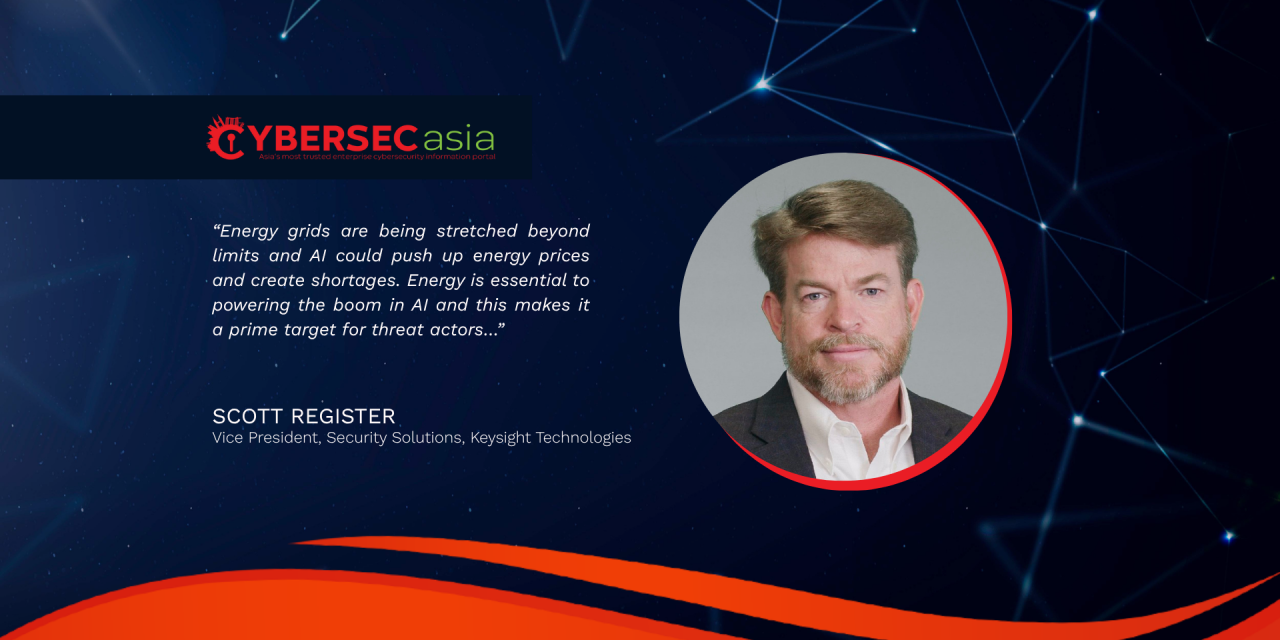
AI’s dependence on the energy grid is clear. The energy requirements of data centers are predicted to skyrocket, especially with more advanced and power-hungry systems on the way. Energy grids are being stretched beyond limits and AI could push up energy prices and create shortages. Energy is essential to powering the boom in AI and this makes it a prime target for threat actors seeking to destabilize AI leadership or dependent critical systems.

In April 2025, we also saw massive blackouts across Spain, Portugal and parts of France that halted public transportation, banking cashpoints and internet connectivity, in one of Europe’s biggest ever power system collapses. Spain, Europe’s fourth-largest economy had no electricity. Whatever the cause, it is an admonitory tale of the importance of a resilient energy grid.

Although some have ruled out cyber-attacks as the cause of the recent blackouts, attacks in the sector are growing. Energy systems are increasingly dependent on IT at every stage of supply chain-generation, transmission, and distribution- all of which must be protected.

AI’s demand for electricity

The world’s data centers are using ever more electricity, the International Energy Agency (IEA) estimates that global electricity usage by data centers will double in just four years, increasing from 460 terawatt hours of electricity in 2022 to 1,000 terawatt hours annually by 2026.

This demand is roughly equivalent to the total electricity consumption of Japan. With governments around the world announcing multi-billion-dollar investments in AI, data center electricity consumption is expected to grow at a rapid pace as AI applications begin to penetrate the market.

Goldman Sachs Research estimates that data center power demand will grow by 160% by 2030. Currently, data centers globally consume 1-2% of overall power, but this percentage will likely double to 3-4% by the end of the decade. The overall increase in data center power consumption from AI is expected to be roughly 200TWh/year between 2023 and 2028, with AI representing about 19% of total data center power demand.

This heightens the dependence as well as the risk profile of the energy systems that support AI data centers and applications, making them targets for cyberattack.

It is also worth highlighting the additional dependency on water consumption. Data centers use fresh mains water, rather than surface water, so that the pipes, pumps, and heat exchangers used to cool racks of servers do not get clogged up with contaminants.

Microsoft’s global water use soared by 34% while it was developing its initial AI tools, and a data center cluster in Iowa used 6% of the district’s water supply in one month during the training of OpenAI’s GPT-4. Therefore, cyber-attacks impacting water supply to the data center operations may also be of concern.

The energy sector is a major target for cyber-attacks

In some parts of the world, energy grids face persistent threats from cybercriminals and hostile states, exploiting ransomware, AI and advanced intrusion tools. State-linked cyber groups increasingly target industrial control systems pivotal to energy infrastructure.

There are major areas of concern in the energy supply chain, where vulnerabilities exist in interconnected systems, for example GNSS and GPS for timing, and the targeting of subsea cables.

For example, in 2021 the Colonial Pipeline ransomware attack disabled its IT computer systems resulting in fuel shortages and panic buying in affected states. In 2022 a Russian attack on satellites knocked out communications and control of thousands of wind turbines in Ukraine. In 2023, the China-linked group, RedEcho, attacked India’s power sector during border tension.

In addition to the IT-focused attacks which have downstream impacts on industrial control systems (ICS), there has also been an increase in ICS-targeting malware intentionally designed for adverse effects on operational technology (OT) environments.

Legislation and proactive cybersecurity testing

Cyber-attacks are why regulators like the US Federal Energy Regulatory Commission (FERC) and North American Electric Reliability Corporation (NERC) are updating their cybersecurity control requirements for grid and power providers, to ensure power companies are preparing for the latest threats.

With cyber-attacks in the energy sector on the rise, it is crucial to implement proactive security measures to safeguard infrastructure and mitigate potential risks. It is important to validate new devices, networks, application workloads and traffic mixes.

But the good news is that security testing solutions can replicate an environment and support a wide range of protocols and applications with real-world test scenarios.

They can help validate and refine energy infrastructure security postures, improving resilience to cyberattacks and ensuring adherence to cyber security requirements with awareness and training, configuration management, incident response, risk assessment, security assessment, access control, identification, and authentication, as well as system and communications protection.

Share:

PreviousRise in state-sponsored cyber-attacks across APAC
NextData analysis based on cyber insurance-driven, multimodal survey data yields expected cyber trends

Related Posts

Four CVSS 9.8 vulnerabilities in failure simulation tool expose Kubernetes clusters to takeover

Four CVSS 9.8 vulnerabilities in failure simulation tool expose Kubernetes clusters to takeover

Thursday, September 18, 2025

Does strengthened identity authentication always impede good customer experience?

Does strengthened identity authentication always impede good customer experience?

Tuesday, April 22, 2025

Data encryption: The mind is willing but the corporation is weak

Data encryption: The mind is willing but the corporation is weak

Friday, April 16, 2021

New app boosts accessibility of community-led security and policing service in Malaysia

New app boosts accessibility of community-led security and policing service in Malaysia

Wednesday, June 14, 2023

Leave a reply Cancel reply

You must be logged in to post a comment.

Voters-draw/RCA-Sponsors

Slide
Slide
Slide
Slide
Slide
Slide
Slide
Slide
Slide
Slide
Slide
Slide
Slide
Slide
previous arrow
next arrow

CybersecAsia Voting Placement

Gamification listing or Participate Now

PARTICIPATE NOW

Vote Now -Placement(Google Ads)

Top-Sidebar-banner

Whitepapers

  • Closing the Gap in Email Security:How To Stop The 7 Most SinisterAI-Powered Phishing Threats

    Closing the Gap in Email Security:How To Stop The 7 Most SinisterAI-Powered Phishing Threats

    Insider threats continue to be a major cybersecurity risk in 2024. Explore more insights on …Download Whitepaper
  • 2024 Insider Threat Report: Trends, Challenges, and Solutions

    2024 Insider Threat Report: Trends, Challenges, and Solutions

    Insider threats continue to be a major cybersecurity risk in 2024. Explore more insights on …Download Whitepaper
  • AI-Powered Cyber Ops: Redefining Cloud Security for 2025

    AI-Powered Cyber Ops: Redefining Cloud Security for 2025

    The future of cybersecurity is a perfect storm: AI-driven attacks, cloud expansion, and the convergence …Download Whitepaper
  • Data Management in the Age of Cloud and AI

    Data Management in the Age of Cloud and AI

    In today’s Asia Pacific business environment, organizations are leaning on hybrid multi-cloud infrastructures and advanced …Download Whitepaper

Middle-sidebar-banner

Case Studies

  • How a Vietnamese D2C retailer built its own secure digital infrastructure

    How a Vietnamese D2C retailer built its own secure digital infrastructure

    Would your organization build your own digital infrastructure – including AI governance and cybersecurity – …Read more
  • Cyber protection for medical clinics in Singapore

    Cyber protection for medical clinics in Singapore

    As Singapore’s healthcare sector becomes increasingly digital and interconnected, clinics are facing heightened cyber risks, …Read more
  • India’s WazirX strengthens governance and digital asset security

    India’s WazirX strengthens governance and digital asset security

    Revamping its custody infrastructure using multi‑party computation tools has improved operational resilience and institutional‑grade safeguardsRead more
  • Bangladesh LGED modernizes communication while addressing data security concerns

    Bangladesh LGED modernizes communication while addressing data security concerns

    To meet emerging data localization/privacy regulations, the government engineering agency deploys a secure, unified digital …Read more

Bottom sidebar

Other News

  • Digital Identity Co. Modernizes Thailand Immigration Bureau Services with AWS

    Friday, May 29, 2026
    Mobile app enables travelers to …Read More »
  • VIVOTEK VORTEX Powers AI Cloud Security in Denmark’s Kongens Ege Mixed-Use Development

    Thursday, May 28, 2026
    TAIPEI, May 28, 2026 /PRNewswire/ …Read More »
  • DJI Releases Findings of the Most Comprehensive Independent Security Assessment of Its Drone Systems to Date

    Thursday, May 28, 2026
    Zero Critical, High, or Medium-Risk …Read More »
  • AUTOCRYPT Achieves WebTrust Accreditation for V2X PKI Infrastructure

    Tuesday, May 26, 2026
    SEOUL, South Korea, May 26, …Read More »
  • CPRO, a Leader in the Physical AI Security Industry, to be Publicly Listed on a U.S. National Securities Exchange Through Business Combination with Lakeshore Acquisition III Corp.

    Tuesday, May 26, 2026
    CPRO is a fast-growing physical …Read More »
  • Our Brands
  • DigiconAsia
  • MartechAsia
  • Home
  • About Us
  • Contact Us
  • Sitemap
  • Privacy & Cookies
  • Terms of Use
  • Advertising & Reprint Policy
  • Media Kit
  • Subscribe
  • Manage Subscriptions
  • Newsletter

Copyright © 2026 CybersecAsia All Rights Reserved.