

Cybersecurity News in Asia

RECENT STORIES:

SEGA moves faster with flow-based network monitoring
Questions over industry influence surface as EU considers forced remov...
OpenAI autonomous agent escapes sandbox to hack Hugging Face
How to manage employee-driven cyber risks during major sporting events
Autonomous AI agent exploits dataset flaws in unprecedented large-scal...
Cohesity Appoints Peter Hanna as Vice President and General Manager, A...
LOGIN REGISTER
CybersecAsia
  • Features
    • Featured

      OpenAI autonomous agent escapes sandbox to hack Hugging Face

      OpenAI autonomous agent escapes sandbox to hack Hugging Face

      Friday, July 24, 2026, 11:02 AM Asia/Singapore | Features, News
    • Featured

      S E Asia governments targeted by cyber-espionage group

      S E Asia governments targeted by cyber-espionage group

      Tuesday, June 23, 2026, 8:00 AM Asia/Singapore | Features
    • Featured

      Rethinking network and infrastructure design for resilience

      Rethinking network and infrastructure design for resilience

      Thursday, June 18, 2026, 2:17 PM Asia/Singapore | Features
  • Opinions
  • Tips
  • Whitepapers
  • AWARDS 2026
  • Directory
  • E-Learning

Select Page

News

Rise in state-sponsored cyber-attacks across APAC

By CybersecAsia editors | Wednesday, July 30, 2025, 9:05 PM Asia/Singapore

Rise in state-sponsored cyber-attacks across APAC

Amid growing supply chain vulnerabilities and a thriving underground economy, APAC is experiencing a notable rise in state-sponsored cyber-attacks. 

Ensign InfoSecurity recently released its sixth Cyber Threat Landscape Report (CTLR) 2025, revealing a significant rise in state-sponsored cyber-attacks across Asia-Pacific (APAC) in 2024. Meanwhile, an increasingly sophisticated underground economy and growing supply chain vulnerabilities are driving the scale and success of attacks across the region.

This report is based on insights drawn from Ensign’s proprietary telemetry and intelligence gathered across the APAC region in 2024. It provides a comprehensive view of the evolving threat landscape Some key findings include:

1. Rising state-sponsored attacks across APAC

State-sponsored threat groups across APAC are on the rise, accounting for a notable number of cyberattacks in 2024. These groups are usually well-resourced and have high-level capabilities. Their modus operandi is characterized by stealth, persistence, and strategic patience, positioning themselves for future operations.

2. Thriving underground economy powers persistent threats

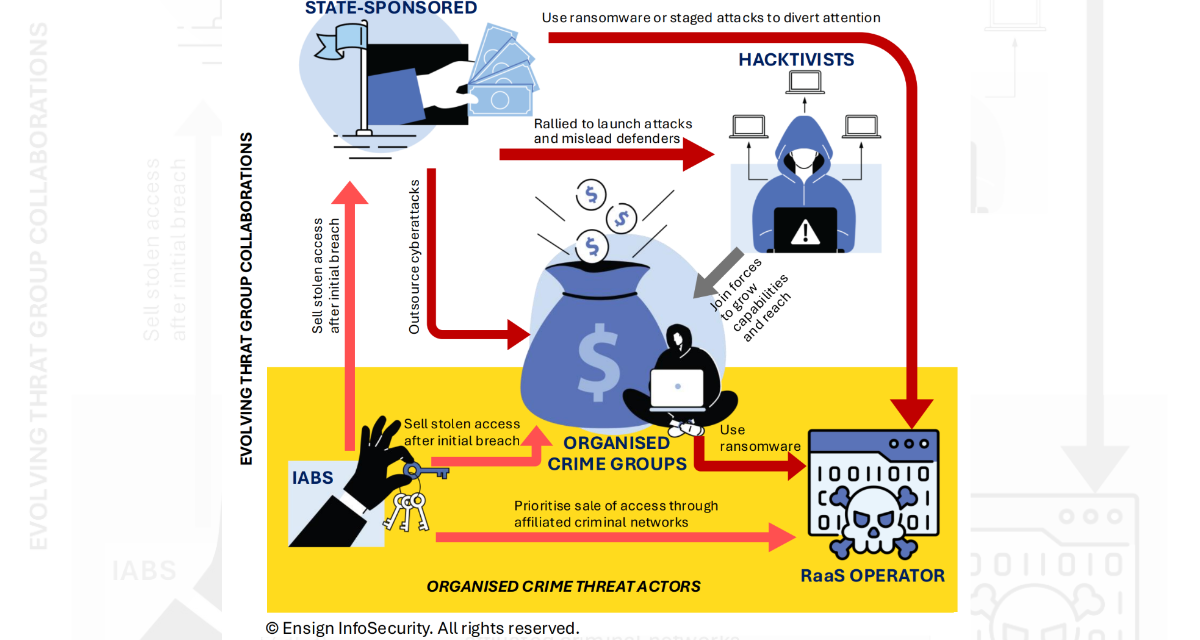
The cyber underground has evolved into a mature and highly collaborative economy. Threat actors including ransomware groups, Initial Access Brokers (IABs), and hacktivists work in tandem; each specializes in a piece of an attack while pursuing multiple income streams. IABs, for instance, have adopted a “breach once, sell to many” model, monetizing initial access by selling it to multiple parties. In the meantime, state-sponsored groups were observed to sub-contract attack tasks to other threat actors, adding layers of complexity to cyber campaigns. Such multi-stakeholder participation in cyberattack campaigns makes it increasingly difficult to attribute attacks to the original masterminds.

“Threat actors are no longer operating in silos. The cyber underground today functions as an illicit, dynamic, and highly collaborative marketplace,” said Xiang Zheng Teo, Vice President of Advisory, Ensign InfoSecurity. “These alliances, combined with widening supply chain vulnerabilities, have made threat groups more capable, persistent, and difficult to dislodge.”

3. Cyber supply chain under sustained attack

The report reveals increasing sophistication in supply chain compromises, where hardware, software, and service providers are targeted for stealthy access into organizations. The Business and Professional Services (BPS) firms, such as legal, accounting, and consulting, have become prime targets. Because of the trusted relationships these firms maintain with their clients, they often possess large amounts of sensitive client data. Yet, they typically lack deep defensive capabilities, making them attractive pathways for attackers seeking broader network penetration.

4. Dwell time quadrupled, indicating growing detection gaps

Notably, compared to 2023, incident-response dwell time (the duration attackers remain undetected within networks) has risen significantly across industries. Across APAC, the maximum dwell quadrupled from 49 to 201 days, while the minimum dwell more than doubled to 7 days. This signals that cyber criminals had a much wider window to steal data, move across networks, and cause damage.

“We are increasingly seeing many organizations being compromised without them even realizing it. As digitization deepens, AI technologies become more pervasive and threat actors grow increasingly sophisticated, organizations must move beyond assumptions of safety,” Teo added. “It is clear that the cyber space is not benign. Organizations must continue to validate their defenses, fix the weak links, and ensure that their cyber posture is operating at a level of readiness that meets today’s threat landscape.”

Share:

PreviousIs your organization truly AI-ready?
NextProactive security to sustain energy and AI

Related Posts

6 practical steps to strengthening M&A cyber due diligence

6 practical steps to strengthening M&A cyber due diligence

Tuesday, October 28, 2025

Time pressure leading to vulnerable apps

Time pressure leading to vulnerable apps

Wednesday, September 30, 2020

global supply chains threatened by DNS attacks

global supply chains threatened by DNS attacks

Wednesday, August 26, 2020

Exposing and tackling hidden software vulnerabilities: it takes a village!

Exposing and tackling hidden software vulnerabilities: it takes a village!

Friday, May 31, 2024

Leave a reply Cancel reply

You must be logged in to post a comment.

Voters-draw/RCA-Sponsors

Slide

CybersecAsia Voting Placement

Gamification listing or Participate Now

PARTICIPATE NOW

Vote Now -Placement(Google Ads)

Top-Sidebar-banner

Whitepapers

  • Critical Security Threatsand the Need for ZTNA: How evolving cyberattacks demand a Zero Trust approach

    Critical Security Threatsand the Need for ZTNA: How evolving cyberattacks demand a Zero Trust approach

    Cyber threats have become more frequent and sophisticated, targeting organizations of all sizes across all …Download Whitepaper
  • Zero Trust Made Simple: Why it matters and how to get started

    Zero Trust Made Simple: Why it matters and how to get started

    Data breaches and cyberattacks are no longer limited to large, high-profile organizations.Download Whitepaper
  • Cloud Secure Edge: Remote access, better security

    Cloud Secure Edge: Remote access, better security

    ​SonicWall Cloud Secure Edge™ is a modern, cloud-native Security Service Edge (SSE) solution that addresses …Download Whitepaper
  • Closing the Gap in Email Security:How To Stop The 7 Most SinisterAI-Powered Phishing Threats

    Closing the Gap in Email Security:How To Stop The 7 Most SinisterAI-Powered Phishing Threats

    Insider threats continue to be a major cybersecurity risk in 2024. Explore more insights on …Download Whitepaper

Middle-sidebar-banner

Case Studies

  • How a Vietnamese D2C retailer built its own secure digital infrastructure

    How a Vietnamese D2C retailer built its own secure digital infrastructure

    Would your organization build your own digital infrastructure – including AI governance and cybersecurity – …Read more
  • Cyber protection for medical clinics in Singapore

    Cyber protection for medical clinics in Singapore

    As Singapore’s healthcare sector becomes increasingly digital and interconnected, clinics are facing heightened cyber risks, …Read more
  • India’s WazirX strengthens governance and digital asset security

    India’s WazirX strengthens governance and digital asset security

    Revamping its custody infrastructure using multi‑party computation tools has improved operational resilience and institutional‑grade safeguardsRead more
  • Bangladesh LGED modernizes communication while addressing data security concerns

    Bangladesh LGED modernizes communication while addressing data security concerns

    To meet emerging data localization/privacy regulations, the government engineering agency deploys a secure, unified digital …Read more

Bottom sidebar

Other News

  • Cohesity Appoints Peter Hanna as Vice President and General Manager, Asia Pacific and Japan

    Thursday, July 23, 2026
    SINGAPORE and HONG KONG, July …Read More »
  • Passport Power Doubles as Global Peace Declines

    Wednesday, July 22, 2026
    LONDON, July 21, 2026 /PRNewswire/ …Read More »
  • Infobip research reveals APAC businesses scaling AI-powered defenses to counter surge in automated fraud

    Tuesday, July 21, 2026
    Fraudsters are leveraging AI to …Read More »
  • SPTel Receives Frost & Sullivan’s 2026 Singapore Company of the Year Recognition for Leadership in Quantum-Safe Network Services

    Tuesday, July 21, 2026
    Recognized for pioneering commercial quantum-safe …Read More »
  • Singtel Receives Four Frost & Sullivan 2026 Recognitions for Leadership in Enterprise Connectivity, Cybersecurity, and Digital Transformation

    Sunday, July 19, 2026
    The recognitions highlight Singtel’s leadership …Read More »
  • Our Brands
  • DigiconAsia
  • MartechAsia
  • Home
  • About Us
  • Contact Us
  • Sitemap
  • Privacy & Cookies
  • Terms of Use
  • Advertising & Reprint Policy
  • Media Kit
  • Subscribe
  • Manage Subscriptions
  • Newsletter

Copyright © 2026 CybersecAsia All Rights Reserved.