
Cybersecurity News in Asia

RECENT STORIES:

SEGA moves faster with flow-based network monitoring
Redefining the future of cyber insurance
When deepfake AI cannot outwit or fool AI-powered real-time biometric ...
Cyber protection for medical clinics in Singapore
Beyond firewalls – addressing cybersecurity blind spots
87% of organizations running software with known, exploitable vulnerab...
LOGIN REGISTER
CybersecAsia
  • Features
    • Featured

      Beyond firewalls – addressing cybersecurity blind spots

      Beyond firewalls – addressing cybersecurity blind spots

      Monday, March 2, 2026, 10:24 AM Asia/Singapore | Features
    • Featured

      Where are financial fraud and AML regulations heading in S E Asia?

      Where are financial fraud and AML regulations heading in S E Asia?

      Tuesday, February 10, 2026, 2:44 PM Asia/Singapore | Features
    • Featured

      How AI is reshaping dating in Asia

      How AI is reshaping dating in Asia

      Monday, February 9, 2026, 5:33 AM Asia/Singapore | Features, Newsletter
  • Opinions
  • Tips
  • Whitepapers
  • Awards 2025
  • Directory
  • E-Learning

Select Page

Opinions

Redefining the future of cyber insurance

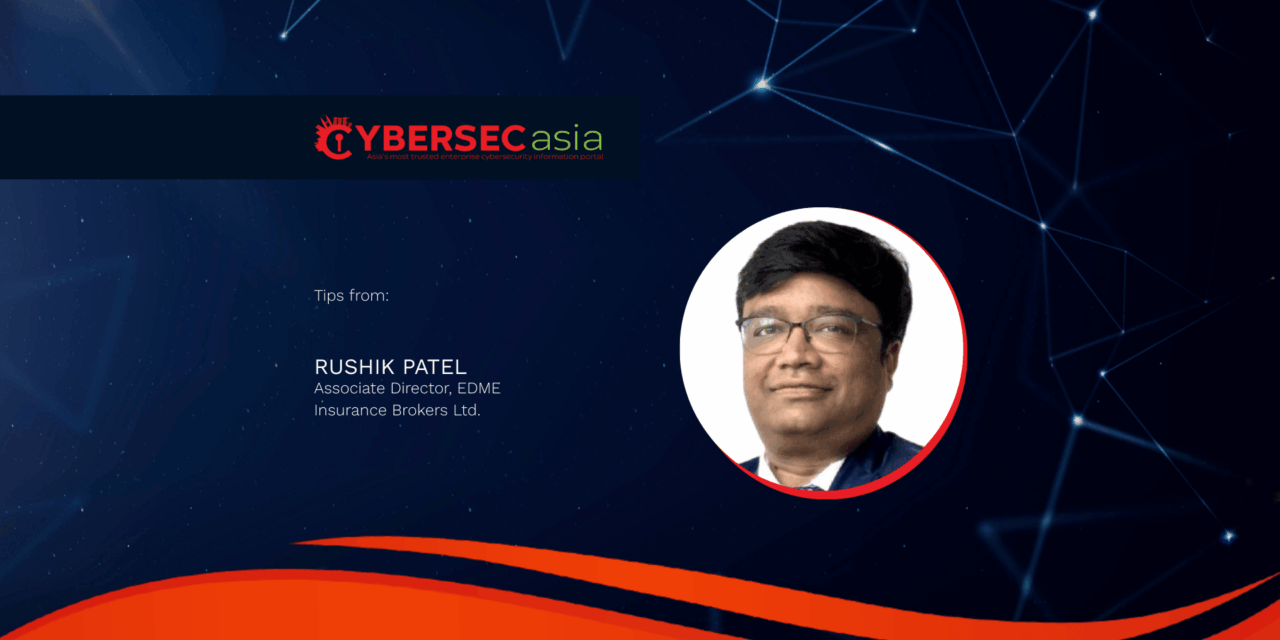
By Rushik Patel, Associate Director, EDME Insurance Brokers Ltd. | Wednesday, March 4, 2026, 10:28 AM Asia/Singapore

Redefining the future of cyber insurance

The cyber insurance market in India is going through a paradigm shift, growing at a CAGR of 20% to 30% over the last few years.

What was a niche service, a post-event financial risk mitigation solution, is now being transformed into a dynamic, real-time risk management platform. This is being triggered by a combination of factors: a perfect storm of digital adoption, regulatory forces, the sophistication of cyber threats, and the realization by boards that cyber risk is a business risk, not an IT risk.

The cyber insurance market in India has been growing at a CAGR of 20% to 30% over the last few years. This growth is underpinned by India’s accelerating digital economy, regulatory frameworks such as the Digital Personal Data Protection (DPDP) Act and increasing awareness of cyber risks across sectors. 

Yet penetration remains below what the risk exposure suggests. At the same time, the risk environment is intensifying. India has experienced more than 2.04 million cybersecurity incidents in a year and hundreds of millions of attempted attacks every year. The economic damage is also equally alarming, with the average cost of cyber incidents in India standing at USD 2.5 million per incident for large businesses.

The growing threat and low insurance penetration are forcing a paradigm shift in how cyber insurance is offered, priced, and structured.

Cyber insurance underwriting has traditionally been based on financial statements, simple IT security data, and risk scores. However, in today’s threat environment, this is no longer adequate. Cyber risk is constantly dynamic, and attack surfaces change every day. Threat actors keep adapting, and vulnerabilities are emerging in real-time.

The insurance industry is now moving from static underwriting to continuous risk assessment, a business model that uses telemetry, threat intelligence, and external attack surface scans to make sense of the changing risk landscape.

This paradigm shift is changing three fundamental elements of cyber insurance:

  • Underwriting: Insurers are now increasingly relying on real-time security ratings, vulnerability scans, and behavioral data to determine risk. This allows underwriting decisions to reflect current cyber posture rather than historical controls.
  • Pricing: Premiums are gradually moving toward dynamic pricing models. Organizations with stronger cyber hygiene and active monitoring are rewarded with better pricing, while deteriorating risk profiles can trigger premium adjustments or coverage restrictions.
  • Risk Mitigation Services: Policies are increasingly bundled with continuous monitoring, incident response support, threat intelligence feeds, and employee awareness programs that is shifting cyber insurance from a reactive payout mechanism to a proactive resilience tool. Regulatory developments are also accelerating the shift toward real-time risk. The DPDP Act and sector-specific cybersecurity guidelines are compelling organizations to implement continuous monitoring, breach detection, and incident reporting capabilities. Cyber insurance is increasingly being aligned with these regulatory requirements.

Moreover, claims experience is reshaping insurer behavior. High claims ratios reportedly exceeding 150–200% for some insurers in recent years have forced them to tighten underwriting standards and invest in better risk visibility.  This further reinforces the move toward real-time risk assessment.

New Entrant: AI

As businesses globally move promptly to embrace artificial intelligence (AI) in their daily operations, insurance ecosystem doesn’t wish to lag. The rapid adoption of artificial intelligence is creating significant challenges for commercial insurance. AI is transforming the cyber insurance market by creating new and complex risk types that do not fit into the traditional underwriting paradigm.

For the insurance industry, artificial intelligence broadens the range of potential cyber events from data theft and ransomware attacks to algorithmic failures, model drift, and “hallucinations” from generative artificial intelligence.

These risks are hard to measure, and the potential systemic risk if widely used tools all fail at once is a concern. The insurance industry will have to improve underwriting guidelines, craft exclusionary language, and consider a specific artificial intelligence liability product.

For policyholders, the impact of AI is to make coverage more complex. While many expect coverage for AI-related failures to be included in existing cyber or professional liability policies, exclusions and definitional issues could create a gap.

For other parties, such as brokers, the issue is to align client expectations with market practice. For brokers, it means managing coverage gaps across multiple lines, while regulators and industry associations are likely to demand a standardized approach to AI risk. In any case, the cyber insurance market is being forced by AI down the same path as cyber risk: from silent coverage to exclusions and finally to affirmative, standalone products that address the distinct risks of AI.

The future of cyber insurance will be shaped by predictive analytics and real-time risk intelligence. Cyber insurers will rely more on AI, machine learning, and threat data to predict losses before they happen. For corporations, this means that cyber insurance will become a strategic asset, fully integrated with enterprise risk management, business continuity planning, and boardroom decision-making.

The challenge for brokers and insurers is to unlock the opportunity to add value outside of the insurance contract, to help customers prevent incidents from occurring in the first place, rather than just mitigating the aftermath.

Cyber insurance will play a vital role in India, where the rate of digital development is currently outstripping the level of maturity in cybersecurity. The coming decade will see cyber insurance develop from a safety net into a real-time risk partner.


Share:

PreviousWhen deepfake AI cannot outwit or fool AI-powered real-time biometric verification

Related Posts

Mitigating the largest cyber-attack to date

Mitigating the largest cyber-attack to date

Friday, August 12, 2022

What do educational institutions do when hit by ransomware?

What do educational institutions do when hit by ransomware?

Friday, July 28, 2023

Five key steps to future-proof your cloud security strategy

Five key steps to future-proof your cloud security strategy

Tuesday, November 3, 2020

Mitigating fraud and identity risk without impairing customer experience

Mitigating fraud and identity risk without impairing customer experience

Friday, April 8, 2022

Leave a reply Cancel reply

You must be logged in to post a comment.

Voters-draw/RCA-Sponsors

Slide
Slide
Slide
Slide
Slide
Slide
Slide
Slide
Slide
Slide
Slide
Slide
Slide
Slide
previous arrow
next arrow

CybersecAsia Voting Placement

Gamification listing or Participate Now

PARTICIPATE NOW

Vote Now -Placement(Google Ads)

Top-Sidebar-banner

Whitepapers

  • Closing the Gap in Email Security:How To Stop The 7 Most SinisterAI-Powered Phishing Threats

    Closing the Gap in Email Security:How To Stop The 7 Most SinisterAI-Powered Phishing Threats

    Insider threats continue to be a major cybersecurity risk in 2024. Explore more insights on …Download Whitepaper
  • 2024 Insider Threat Report: Trends, Challenges, and Solutions

    2024 Insider Threat Report: Trends, Challenges, and Solutions

    Insider threats continue to be a major cybersecurity risk in 2024. Explore more insights on …Download Whitepaper
  • AI-Powered Cyber Ops: Redefining Cloud Security for 2025

    AI-Powered Cyber Ops: Redefining Cloud Security for 2025

    The future of cybersecurity is a perfect storm: AI-driven attacks, cloud expansion, and the convergence …Download Whitepaper
  • Data Management in the Age of Cloud and AI

    Data Management in the Age of Cloud and AI

    In today’s Asia Pacific business environment, organizations are leaning on hybrid multi-cloud infrastructures and advanced …Download Whitepaper

Middle-sidebar-banner

Case Studies

  • Cyber protection for medical clinics in Singapore

    Cyber protection for medical clinics in Singapore

    As Singapore’s healthcare sector becomes increasingly digital and interconnected, clinics are facing heightened cyber risks, …Read more
  • India’s WazirX strengthens governance and digital asset security

    India’s WazirX strengthens governance and digital asset security

    Revamping its custody infrastructure using multi‑party computation tools has improved operational resilience and institutional‑grade safeguardsRead more
  • Bangladesh LGED modernizes communication while addressing data security concerns

    Bangladesh LGED modernizes communication while addressing data security concerns

    To meet emerging data localization/privacy regulations, the government engineering agency deploys a secure, unified digital …Read more
  • What AI worries keep members of the Association of Certified Fraud Examiners sleepless?

    What AI worries keep members of the Association of Certified Fraud Examiners sleepless?

    This case study examines how many anti-fraud professionals reported feeling underprepared to counter rising AI-driven …Read more

Bottom sidebar

Other News

  • DoveRunner Expands Presence in Southeast Asia with New Office in Jakarta

    Thursday, February 26, 2026
    JAKARTA, Indonesia, Feb. 25, 2026 …Read More »
  • Proofpoint partners with Concentrix to strengthen human- and agent-centric cybersecurity across Asia Pacific

    Tuesday, February 24, 2026
    Partnership integrates Proofpoint’s collaboration and …Read More »
  • Indonesia’s MDI Ventures Doubles Down on Execution and Trust to Unlock Regional Portfolio Value

    Friday, February 20, 2026
    The Telkom-backed VC reinforces cross-sector …Read More »
  • Blackpanda Japan Announces Strategic Partnership with SoftBank to Strengthen Cyber Incident Response in Japan

    Wednesday, February 11, 2026
    SINGAPORE, Feb. 10, 2026 /PRNewswire/ …Read More »
  • Cohesity Collaborates with Google Cloud to Deliver Secure Sandbox Capabilities and Comprehensive Threat Insights Designed to Eliminate Hidden Malware

    Saturday, February 7, 2026
    Embedded Google Threat Intelligence capabilities, …Read More »
  • Our Brands
  • DigiconAsia
  • MartechAsia
  • Home
  • About Us
  • Contact Us
  • Sitemap
  • Privacy & Cookies
  • Terms of Use
  • Advertising & Reprint Policy
  • Media Kit
  • Subscribe
  • Manage Subscriptions
  • Newsletter

Copyright © 2026 CybersecAsia All Rights Reserved.