



Cybersecurity News in Asia

RECENT STORIES:

SEGA moves faster with flow-based network monitoring
Taiwan high-speed rail spoofing case exposes OT governance gaps, not i...
Linux kernel zero day enables root privilege escalation across most di...
Are AI-powered cyber threats evolving faster than courts and police ca...
Hackers leverage jailbroken AI to probe OT systems in Mexican Water Br...
Which four tech brands were most exploited in phishing and social medi...
LOGIN REGISTER
CybersecAsia
  • Features
    • Featured

      Are AI-powered cyber threats evolving faster than courts and police can adapt?

      Are AI-powered cyber threats evolving faster than courts and police can adapt?

      Monday, May 11, 2026, 8:30 AM Asia/Singapore | Features
    • Featured

      The problem with CAPTCHAs – and the password perception gap

      The problem with CAPTCHAs - and the password perception gap

      Thursday, May 7, 2026, 11:14 AM Asia/Singapore | Features
    • Featured

      How AI is supercharging insider threats

      How AI is supercharging insider threats

      Wednesday, April 15, 2026, 12:29 PM Asia/Singapore | Features
  • Opinions
  • Tips
  • Whitepapers
  • Directory
  • E-Learning

Select Page

News

Can your anti-phishing software detect these new URLO obfuscation techniques?

By CybersecAsia editors | Friday, September 12, 2025, 8:33 AM Asia/Singapore

Can your anti-phishing software detect these new URLO obfuscation techniques?

Cybercriminals are employing novel ways such as invisible spaces and confusing URLs to foil email scanning software and wary users.

Phishing emails and social media posts often contain harmful links that direct victims to fake websites where they could be tricked into downloading malware or reveal personal information such as login IDs and passwords.

As security systems become better at spotting these malicious links, cybercriminals are developing crafty new ways to hide them and slip past defenses unnoticed.

On 9 September 2025, one cybersecurity firm has shared some new findings about several clever tricks being used to obscure actual URLs. The methods are: Inserting invisible spaces (code %20) and unusual characters into web addresses, to push the malicious part of the link out of sight of security scanners or suspicious eyes. Attackers can also add fake elements such as a hidden email address or secret codes at the end of the links that can track victims or redirect them to malicious sites. To make their trap look more convincing, the attackers sometimes include fake verification tests such as CAPTCHA prompts that make the site appear legitimate.

  • Inserting invisible spaces (code %20) and unusual characters into web addresses, to push the malicious part of the link out of sight of security scanners or suspicious eyes. Attackers can also add fake elements such as a hidden email address or secret codes at the end of the links that can track victims or redirect them to malicious sites. To make their trap look more convincing, the attackers sometimes include fake verification tests such as CAPTCHA prompts that make the site appear legitimate.

    E.g.: A malicious URL padded with invisible spaces to be visually broken up into two parts that look harmless.
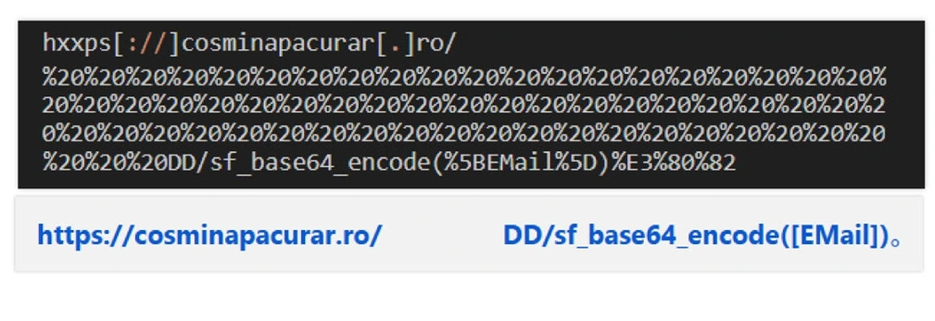
  • Using the Redundant Protocol Prefix technique to craft a URL that is only partially hyperlinked or that contains invalid elements (such as two ‘https’ or no ‘//’) to hide the real destination of the link while ensuring the active part looks benign and legitimate and does not arouse suspicion.

    This approach can also involve crafting links with multiple protocol prefixes or embedding trusted-looking names before the “@” symbol in URLs. This tricks users and security filters into believing the link is safe, while the real malicious site is hidden after the “@.”
    Attackers can also use strange symbols such as backslashes or dollar signs (which are not normally used in URLs) to confuse scanning software.

    E.g.: The link https:office365Scaffidips[.]azgcvhzauig[.]es\If04 looks harmless, but actually sends the browser to a malicious page azgcvhzauig.es
  • Creating fake domain names that look like official company subdomains, which further fools people into trusting the site. When users copy and paste these deceptive links, they land on well-designed phishing pages created to steal login credentials.

    E.g.: The link office365Scaffidips.azgcvhzauig.es. gives the impression that the user is dealing with a Microsoft subdomain. However, the last part of the web address: ‘azgcvhzauig.es’ is the attacker-owned phishing site.

Such evolving tactics highlight how cybercriminals constantly invent new methods to hide their threats.

According to Saravanan Mohankumar, Manager, Threat Analysis team, Barracuda, the firm sharing its threat intelligence findings: “The best defence… is a multilayered approach, with various levels of security that can spot, inspect and block unusual or unexpected activity. Solutions that include AI and machine-learning capabilities, both at the email gateway level and post-delivery, will ensure companies are well protected… Security measures should be complemented by active and regular security awareness training for employees.”


Share:

PreviousAduna and Soprano Design, Partner to Expand Network API Adoption Across Australia and Global Markets
NextVehere Elevates Sanjay Bhardwaj to Managing Director, India and ASEAN

Related Posts

Patching Exchange Server vulnerabilities not enough

Patching Exchange Server vulnerabilities not enough

Friday, February 18, 2022

Stalkerware abuse: time to tighten the noose?

Stalkerware abuse: time to tighten the noose?

Thursday, March 16, 2023

BYOD policies increase the attack surface but firms can manage the risk

BYOD policies increase the attack surface but firms can manage the risk

Friday, November 4, 2022

How Kyocera exceeds customer expectations with AI-based endpoint security

How Kyocera exceeds customer expectations with AI-based endpoint security

Friday, August 6, 2021

Leave a reply Cancel reply

You must be logged in to post a comment.

Voters-draw/RCA-Sponsors

Slide
Slide
Slide
Slide
Slide
Slide
Slide
Slide
Slide
Slide
Slide
Slide
Slide
Slide
previous arrow
next arrow

CybersecAsia Voting Placement

Gamification listing or Participate Now

PARTICIPATE NOW

Vote Now -Placement(Google Ads)

Top-Sidebar-banner

Whitepapers

  • Closing the Gap in Email Security:How To Stop The 7 Most SinisterAI-Powered Phishing Threats

    Closing the Gap in Email Security:How To Stop The 7 Most SinisterAI-Powered Phishing Threats

    Insider threats continue to be a major cybersecurity risk in 2024. Explore more insights on …Download Whitepaper
  • 2024 Insider Threat Report: Trends, Challenges, and Solutions

    2024 Insider Threat Report: Trends, Challenges, and Solutions

    Insider threats continue to be a major cybersecurity risk in 2024. Explore more insights on …Download Whitepaper
  • AI-Powered Cyber Ops: Redefining Cloud Security for 2025

    AI-Powered Cyber Ops: Redefining Cloud Security for 2025

    The future of cybersecurity is a perfect storm: AI-driven attacks, cloud expansion, and the convergence …Download Whitepaper
  • Data Management in the Age of Cloud and AI

    Data Management in the Age of Cloud and AI

    In today’s Asia Pacific business environment, organizations are leaning on hybrid multi-cloud infrastructures and advanced …Download Whitepaper

Middle-sidebar-banner

Case Studies

  • Cyber protection for medical clinics in Singapore

    Cyber protection for medical clinics in Singapore

    As Singapore’s healthcare sector becomes increasingly digital and interconnected, clinics are facing heightened cyber risks, …Read more
  • India’s WazirX strengthens governance and digital asset security

    India’s WazirX strengthens governance and digital asset security

    Revamping its custody infrastructure using multi‑party computation tools has improved operational resilience and institutional‑grade safeguardsRead more
  • Bangladesh LGED modernizes communication while addressing data security concerns

    Bangladesh LGED modernizes communication while addressing data security concerns

    To meet emerging data localization/privacy regulations, the government engineering agency deploys a secure, unified digital …Read more
  • What AI worries keep members of the Association of Certified Fraud Examiners sleepless?

    What AI worries keep members of the Association of Certified Fraud Examiners sleepless?

    This case study examines how many anti-fraud professionals reported feeling underprepared to counter rising AI-driven …Read more

Bottom sidebar

Other News

  • VIVOTEK AI Solutions Enhance Efficiency at Traffic Hubs in Norway

    Wednesday, May 6, 2026
    TAIPEI, May 6, 2026 /PRNewswire/ …Read More »
  • Taoping Reports Fiscal Year 2025 Results

    Thursday, April 30, 2026
    Strategic Transformation Drives Platform Expansion, …Read More »
  • DESILO Launches World’s First Fully Homomorphic Encryption Library Integrating 5th-Generation FHE Scheme ‘GL’, Accelerating the Era of Private AI

    Tuesday, April 28, 2026
    SEOUL, South Korea, April 28, …Read More »
  • Tencent Cloud Cube Sandbox Goes Fully Open-Source, with Five Major Breakthroughs Enabling Large-Scale Agent Deployment

    Thursday, April 23, 2026
    Tencent Cloud’s Cube Sandbox goes …Read More »
  • Sparrow to Demonstrate AI-Driven Security and SBOM Management at Black Hat Asia 2026

    Wednesday, April 22, 2026
    SINGAPORE, April 21, 2026 /PRNewswire/ …Read More »
  • Our Brands
  • DigiconAsia
  • MartechAsia
  • Home
  • About Us
  • Contact Us
  • Sitemap
  • Privacy & Cookies
  • Terms of Use
  • Advertising & Reprint Policy
  • Media Kit
  • Subscribe
  • Manage Subscriptions
  • Newsletter

Copyright © 2026 CybersecAsia All Rights Reserved.