



Cybersecurity News in Asia

RECENT STORIES:

SEGA moves faster with flow-based network monitoring
AI agents are turning “always‑on” access into a ghost admin problem...
Sports loses trust as fans compete with bots
US Treasury sanctions VPN provider accused of supporting ransomware op...
US CISA advisory highlights ongoing state-sponsored attacks on routers...
CloudMile and Tookitaki Sign MoU to Strengthen AI-Driven Financial Cri...
LOGIN REGISTER
CybersecAsia
  • Features
    • Featured

      S E Asia governments targeted by cyber-espionage group

      S E Asia governments targeted by cyber-espionage group

      Tuesday, June 23, 2026, 8:00 AM Asia/Singapore | Features
    • Featured

      Rethinking network and infrastructure design for resilience

      Rethinking network and infrastructure design for resilience

      Thursday, June 18, 2026, 2:17 PM Asia/Singapore | Features
    • Featured

      Bringing cybercriminals to justice in APAC

      Bringing cybercriminals to justice in APAC

      Thursday, June 11, 2026, 10:30 AM Asia/Singapore | Features
  • Opinions
  • Tips
  • Whitepapers
  • AWARDS 2026
  • Directory
  • E-Learning

Select Page

Features

What happened with Cloudflare?

By Victor Ng | Wednesday, November 19, 2025, 11:35 AM Asia/Singapore

What happened with Cloudflare?

For a couple of hours last night, every one out of 4 websites I tried to access showed an error page.

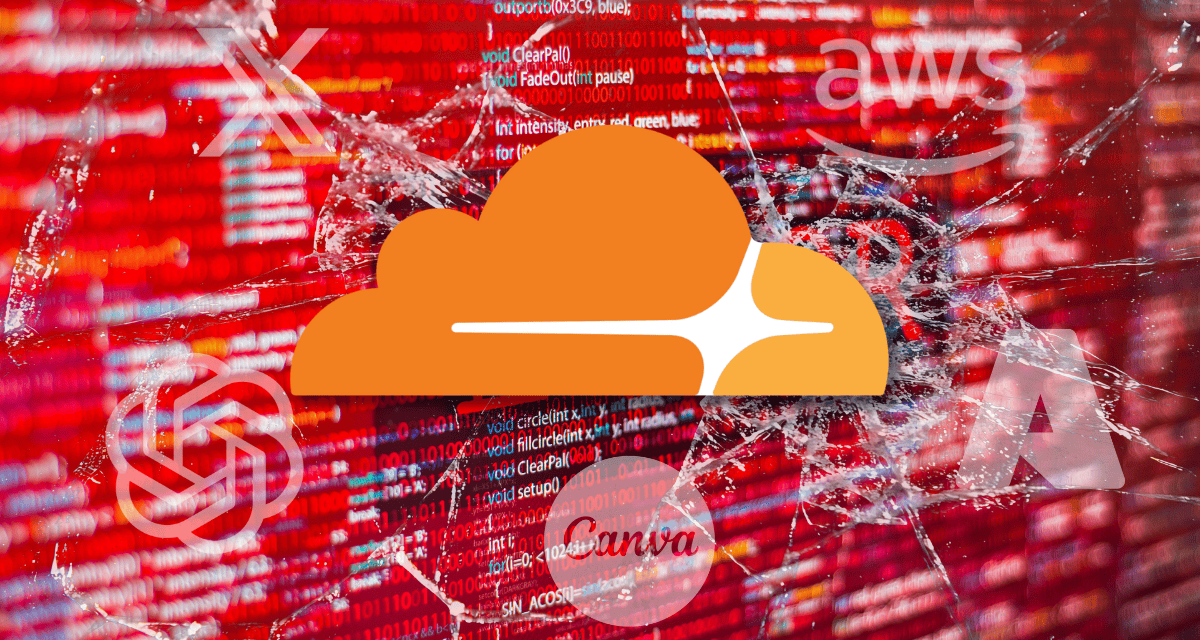
Millions of users worldwide trying to access many popular websites such as ChatGPT, X (formerly Twitter), Canva, and League of Legends,  were unable to, when Cloudflare had an outage. 

All these websites were functioning properly, but because they leveraged Cloudflare’s DNS services, users were not able to access these sites. 

The services recovered subsequently, but this brings to light the importance of service resilience, availability and independence.

What happened
According to Oded Vanunu, Head of Vulnerability Research, Check Point Software: “Cloudflare provides DNS services, the mechanism that translates domain names into IP addresses. When this service is disrupted, browsers fail to resolve addresses, and connections to servers break.”

 The result: many websites and services become inaccessible even if the servers themselves are operational.

“Beyond DNS, Cloudflare operates a CDN network that accelerates browsing by distributing content copies across servers closer to users,” he added.

 “A CDN failure forces all requests to reach the original server, sometimes located far away geographically, which slows loading times and increases core infrastructure load.”

The repercussions

Graeme Stewart, head of public sector, Check Point Software, commented: “Cloudflare going down sits in the same pattern we saw with the recent AWS and Azure outages.

These platforms are vast, efficient and used by almost every part of modern life, he said. “The upside is obvious. Their scale keeps costs low, makes security tools more accessible and gives even small organizations the kind of performance that would once have been impossible.”

The downside is just as clear. “When a platform of this size slips, the impact spreads far and fast and everyone feels it at once.”

According to some research, Cloudflare has more than 20% of the global DNS market, powering access to one-third of the world’s 10,000 most popular sites.

Jake Moore, Global Security Advisor, ESET, added: “The outages we have witnessed the last few months have once again highlighted the reliance on these fragile networks. Companies are often forced to heavily rely on the likes of Cloudflare, Microsoft, and Amazon for hosting their websites and services as there aren’t many other options.”

Moore observed that the problems causing these outages have occurred due to DNS servers that are most likely overwhelmed: “The technology is based on an outdated, legacy network that redirects words in a web addresses into computer-friendly numbers. When this system fails, it catastrophically collapses and causes these outages. However, the problem is that this system cannot be replaced easily. It may sound risky but the major cloud providers actually have lots of impressive failsafes in place and usually provide more protection than the lesser well known cloud providers.”

What does that mean for government and public services? 

Stewart said: “During today’s outage, news sites, payments, public information pages and community services all froze.”
That was not because any of these organizations failed on its own. It was because a single layer they all rely on stopped responding.
“People saw a simple error page, but the break reached into the systems that hold up essential services,” continued Stewart.

“From a cybersecurity view, this is the part that matters. Any platform that carries this much of the world’s traffic becomes a target.”

Possible exploits
He warned that even an accidental outage can create noise and uncertainty that attackers know how to exploit.

He explained: “If an incident of this scale were triggered deliberately, the disruption would spread across countries that use these platforms to communicate with the public and deliver basic services.”

With many organizations still running everything through one route with no meaningful backup, a failure along that route means there is no fallback.

“That is the weakness we keep seeing play out,” Stewart emphasized. “The internet was meant to be resilient through distribution, yet we have ended up concentrating huge amounts of global traffic into a handful of cloud providers.”

“Large platforms bring benefits, but events like today show the cost of that decision. Until there is real diversity and redundancy in the system, each outage will hit people harder than it should,” he warned.




Share:

PreviousTelecoms and regulators unite to tackle scams in the Philippines
NextMajor internet infrastructure outage disrupts access to numerous popular platforms

Related Posts

Regaining control over personal data

Regaining control over personal data

Monday, September 23, 2019

Real reCaptcha walls camouflage fake sites

Real reCaptcha walls camouflage fake sites

Friday, May 8, 2020

Cyber vigilance through recognizing the domino effect

Cyber vigilance through recognizing the domino effect

Monday, March 21, 2022

Impact of digitalization on OT security

Impact of digitalization on OT security

Tuesday, September 13, 2022

Leave a reply Cancel reply

You must be logged in to post a comment.

Voters-draw/RCA-Sponsors

Slide

CybersecAsia Voting Placement

Gamification listing or Participate Now

PARTICIPATE NOW

Vote Now -Placement(Google Ads)

Top-Sidebar-banner

Whitepapers

  • Critical Security Threatsand the Need for ZTNA: How evolving cyberattacks demand a Zero Trust approach

    Critical Security Threatsand the Need for ZTNA: How evolving cyberattacks demand a Zero Trust approach

    Cyber threats have become more frequent and sophisticated, targeting organizations of all sizes across all …Download Whitepaper
  • Zero Trust Made Simple: Why it matters and how to get started

    Zero Trust Made Simple: Why it matters and how to get started

    Data breaches and cyberattacks are no longer limited to large, high-profile organizations.Download Whitepaper
  • Cloud Secure Edge: Remote access, better security

    Cloud Secure Edge: Remote access, better security

    ​SonicWall Cloud Secure Edge™ is a modern, cloud-native Security Service Edge (SSE) solution that addresses …Download Whitepaper
  • Closing the Gap in Email Security:How To Stop The 7 Most SinisterAI-Powered Phishing Threats

    Closing the Gap in Email Security:How To Stop The 7 Most SinisterAI-Powered Phishing Threats

    Insider threats continue to be a major cybersecurity risk in 2024. Explore more insights on …Download Whitepaper

Middle-sidebar-banner

Case Studies

  • How a Vietnamese D2C retailer built its own secure digital infrastructure

    How a Vietnamese D2C retailer built its own secure digital infrastructure

    Would your organization build your own digital infrastructure – including AI governance and cybersecurity – …Read more
  • Cyber protection for medical clinics in Singapore

    Cyber protection for medical clinics in Singapore

    As Singapore’s healthcare sector becomes increasingly digital and interconnected, clinics are facing heightened cyber risks, …Read more
  • India’s WazirX strengthens governance and digital asset security

    India’s WazirX strengthens governance and digital asset security

    Revamping its custody infrastructure using multi‑party computation tools has improved operational resilience and institutional‑grade safeguardsRead more
  • Bangladesh LGED modernizes communication while addressing data security concerns

    Bangladesh LGED modernizes communication while addressing data security concerns

    To meet emerging data localization/privacy regulations, the government engineering agency deploys a secure, unified digital …Read more

Bottom sidebar

Other News

  • CloudMile and Tookitaki Sign MoU to Strengthen AI-Driven Financial Crime Prevention in Malaysia

    Wednesday, July 15, 2026
    KUALA LUMPUR, Malaysia, July 15, …Read More »
  • VIDA Demonstrates How Passwordless Authentication Can Break the Scam Chain

    Monday, July 13, 2026
    KUALA LUMPUR, Malaysia, July 13, …Read More »
  • Sparsa AI Launches Sovereign Enterprise AI Platform with Global Deployment at QNET

    Wednesday, July 8, 2026
    The Sparsa AI Enterprise Operating …Read More »
  • Conifers AI Opens Singapore Data Region, Bringing Local Data Residency to Asia-Pacific Security Teams

    Wednesday, July 8, 2026
    With data regions now spanning …Read More »
  • DXC Opens Flagship AI-first Customer Experience Center in Bengaluru

    Tuesday, July 7, 2026
    Strengthens DXC’s India presence with …Read More »
  • Our Brands
  • DigiconAsia
  • MartechAsia
  • Home
  • About Us
  • Contact Us
  • Sitemap
  • Privacy & Cookies
  • Terms of Use
  • Advertising & Reprint Policy
  • Media Kit
  • Subscribe
  • Manage Subscriptions
  • Newsletter

Copyright © 2026 CybersecAsia All Rights Reserved.