
Cybersecurity News in Asia

RECENT STORIES:

SEGA moves faster with flow-based network monitoring
AI agent executes end-to-end ransomware attack via development platfor...
ICAC Commissioner attends first IAACA European regional anti-corruptio...
Research: Asian enterprises advancing AI without resilience strategies...
Penta Security Sets the Benchmark for Web Application Security, Earnin...
India bank domain registry exposed sensitive data in security lapse: e...
LOGIN REGISTER
CybersecAsia
  • Features
    • Featured

      S E Asia governments targeted by cyber-espionage group

      S E Asia governments targeted by cyber-espionage group

      Tuesday, June 23, 2026, 8:00 AM Asia/Singapore | Features
    • Featured

      Rethinking network and infrastructure design for resilience

      Rethinking network and infrastructure design for resilience

      Thursday, June 18, 2026, 2:17 PM Asia/Singapore | Features
    • Featured

      Bringing cybercriminals to justice in APAC

      Bringing cybercriminals to justice in APAC

      Thursday, June 11, 2026, 10:30 AM Asia/Singapore | Features
  • Opinions
  • Tips
  • Whitepapers
  • AWARDS 2026
  • Directory
  • E-Learning

Select Page

Features

Web browsers that rank lowest for privacy protection

By CybersecAsia editors | Wednesday, December 10, 2025, 8:30 AM Asia/Singapore

Web browsers that rank lowest for privacy protection

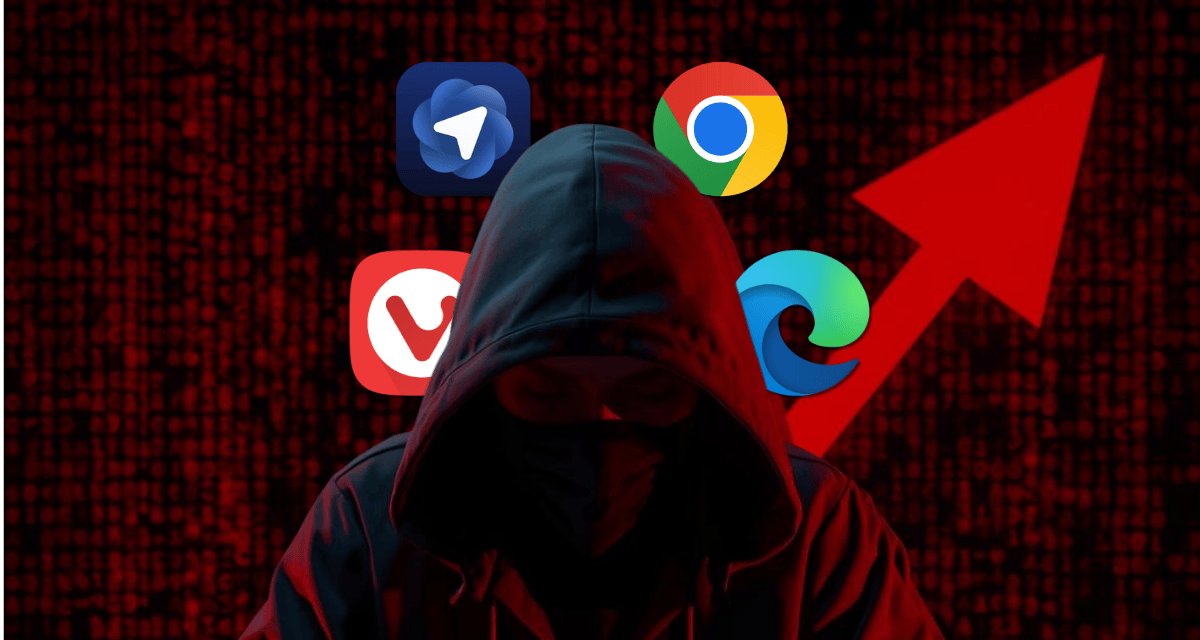
According to a December 2025 report on browser privacy, the newly released ChatGPT Atlas ranks as the least secure web client. 

With the recent wave of AI browsing tools, a timely study by iGaming software provider Digitain examined 13 popular browsers across different security features.

Key highlights of the report include:

  • ChatGPT Atlas failed 100% of state partitioning tests, meaning it cannot prevent websites from tracking users across different browsing sessions.
  • Chrome ranks among the worst for privacy despite its popularity, scoring only 41 out of 100 for securing how it connects you to websites.
  • Brave and Mullvad are the safest options, keeping your browsing activity completely private from advertisers and data collectors.

Each browser went through dozens of technical tests that checked three main things: whether websites can identify and track you across the internet (called fingerprinting and tracking), whether the browser blocks companies from collecting your data through cookies and trackers, and whether your connection stays secure when you move between websites. 

Browsers got scored in each category, and those scores were combined into a final Privacy Risk Score from 1 to 99. The higher your score, the worse your browser is at protecting you, with 99 meaning almost no privacy protection at all.

Paruyr Harutyunyan, Group Head, Digital Marketing, Digitain, commented: “New AI-powered browsers like ChatGPT Atlas and Comet from Perplexity are getting a lot of attention right now, and millions of people are trying them out because of the AI hype.”

Just because something uses AI doesn’t automatically make it safe or private. In fact, it may even be worse for privacy protection.

He warned: “These browsers come with interesting features that traditional ones don’t have, but users need to stop and check how secure they actually are. AI works by collecting and learning from data, which means these tools might be gathering more of your personal information than you realize.”

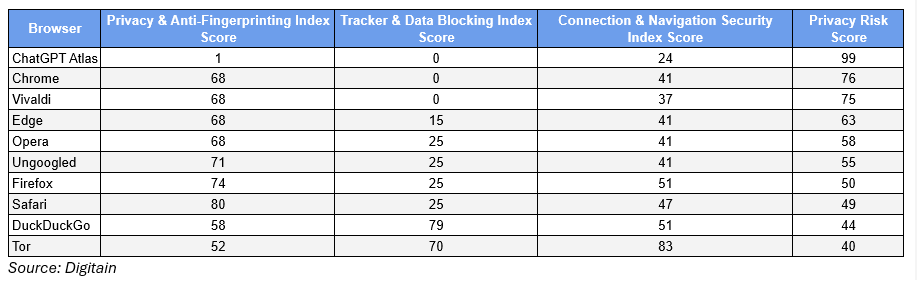
Here’s a quick look at the 10 browsers with the highest privacy risks:
What follow are the details of the 5 least private browsers:

1. ChatGPT Atlas

  • Privacy & Anti-Fingerprinting Index Score: 1 out of 100
  • Tracker & Data Blocking Index Score: 0 out of 100
  • Connection & Navigation Security Index Score: 24 out of 100
  • Privacy Risk Score: 99

ChatGPT Atlas is the least private browser of all. OpenAI’s newly launched tool failed nearly every privacy test conducted in the study, scoring just 1 point in anti-fingerprinting protection and 0 in tracker blocking. 

The browser provides no defense against websites collecting user data through cookies, query parameters, or content trackers. ChatGPT Atlas also performed poorly in basic security measures, managing only 24 points out of 100 for connection and navigation security.

2. Chrome

Chrome comes second with a privacy risk score of 76, despite being the world’s most popular browser. Google’s browser scored 68 in stopping websites from identifying you but received 0 points for blocking trackers, meaning companies can freely follow your activity across the web. 

Chrome doesn’t block tracking cookies or the hidden markers that websites use to monitor where you go online. The browser earned 41 points for connection security, falling well below privacy-focused alternatives.

3. Vivaldi

Vivaldi ranks third among the least private web clients. The browser matched Chrome’s 68-point anti-fingerprinting score but similarly failed to block any trackers, recording 0 in that category. Vivaldi’s connection security also came in slightly lower at 37 points compared to Chrome’s 41. 

Despite marketing itself as a privacy-conscious alternative to mainstream browsers, Vivaldi’s test results show it offers low protection against online tracking and data harvesting.

4. Edge

Next comes Microsoft Edge. The browser posted the same 68 points as Chrome and Vivaldi for anti-fingerprinting but showed slight improvement in tracker blocking with a score of 15 out of 100. Edge tied with Chrome’s connection security rating at 41 points. 

While Edge performs marginally better than Chrome and Vivaldi, it still fails to provide adequate privacy protection for users concerned about data collection and online tracking.

5. Opera

Opera rounds out the five least private browsers. Like other Chromium-based browsers in this ranking, Opera scored 68 for anti-fingerprinting and 41 for connection security. However, Opera showed slightly better tracker blocking capabilities with 25 points, putting it ahead of Edge, Vivaldi, and Chrome in this category. 

Despite these small improvements, Opera still ranks among browsers that offer poor overall privacy protection.

Share:

PreviousThe impact of APAC’s AI buildout on cybersecurity in 2026
NextTackling next year’s enterprise cyber resilience trends: five strategic priorities for CISOs

Related Posts

Gen Z or Millennial working from home? These tips can keep you safe!

Gen Z or Millennial working from home? These tips can keep you safe!

Thursday, July 8, 2021

Poorly secured APIs an emerging threat: survey

Poorly secured APIs an emerging threat: survey

Tuesday, October 8, 2024

Microsegmentation – the zero trust shift from breach prevention to breach readiness

Microsegmentation – the zero trust shift from breach prevention to breach readiness

Wednesday, September 11, 2024

Fighting digital fraud with digital firepower in the financial sector

Fighting digital fraud with digital firepower in the financial sector

Friday, December 4, 2020

Leave a reply Cancel reply

You must be logged in to post a comment.

Voters-draw/RCA-Sponsors

Slide
Slide
Slide
Slide
Slide
Slide
Slide
Slide
Slide
Slide
Slide
Slide
Slide
Slide
previous arrow
next arrow

CybersecAsia Voting Placement

Gamification listing or Participate Now

PARTICIPATE NOW

Vote Now -Placement(Google Ads)

Top-Sidebar-banner

Whitepapers

  • Critical Security Threatsand the Need for ZTNA: How evolving cyberattacks demand a Zero Trust approach

    Critical Security Threatsand the Need for ZTNA: How evolving cyberattacks demand a Zero Trust approach

    Cyber threats have become more frequent and sophisticated, targeting organizations of all sizes across all …Download Whitepaper
  • Zero Trust Made Simple: Why it matters and how to get started

    Zero Trust Made Simple: Why it matters and how to get started

    Data breaches and cyberattacks are no longer limited to large, high-profile organizations.Download Whitepaper
  • Cloud Secure Edge: Remote access, better security

    Cloud Secure Edge: Remote access, better security

    ​SonicWall Cloud Secure Edge™ is a modern, cloud-native Security Service Edge (SSE) solution that addresses …Download Whitepaper
  • Closing the Gap in Email Security:How To Stop The 7 Most SinisterAI-Powered Phishing Threats

    Closing the Gap in Email Security:How To Stop The 7 Most SinisterAI-Powered Phishing Threats

    Insider threats continue to be a major cybersecurity risk in 2024. Explore more insights on …Download Whitepaper

Middle-sidebar-banner

Case Studies

  • How a Vietnamese D2C retailer built its own secure digital infrastructure

    How a Vietnamese D2C retailer built its own secure digital infrastructure

    Would your organization build your own digital infrastructure – including AI governance and cybersecurity – …Read more
  • Cyber protection for medical clinics in Singapore

    Cyber protection for medical clinics in Singapore

    As Singapore’s healthcare sector becomes increasingly digital and interconnected, clinics are facing heightened cyber risks, …Read more
  • India’s WazirX strengthens governance and digital asset security

    India’s WazirX strengthens governance and digital asset security

    Revamping its custody infrastructure using multi‑party computation tools has improved operational resilience and institutional‑grade safeguardsRead more
  • Bangladesh LGED modernizes communication while addressing data security concerns

    Bangladesh LGED modernizes communication while addressing data security concerns

    To meet emerging data localization/privacy regulations, the government engineering agency deploys a secure, unified digital …Read more

Bottom sidebar

Other News

  • ICAC Commissioner attends first IAACA European regional anti-corruption conference in Hungary

    Friday, July 3, 2026
    BUDAPEST, Hungary, July 2, 2026 …Read More »
  • Penta Security Sets the Benchmark for Web Application Security, Earning Frost & Sullivan’s 2026 South Korea Company of the Year Recognition

    Thursday, July 2, 2026
    By combining intelligent threat detection, …Read More »
  • SK shieldus Receives Frost & Sullivan’s 2026 APAC Customer Value Leadership Recognition for Excellence in Cybersecurity Services

    Monday, June 29, 2026
    The company is recognized for …Read More »
  • Global Tech Shift: Tune Talk Launches World’s First Network-Enforced Child Safety Mobile Plan, Bypassing App-Level Limitations

    Saturday, June 27, 2026
    PETALING JAYA, Malaysia, June 26, …Read More »
  • DJI Enterprise Advances Industry with New Framework for Dock as First Responder (DFR) Deployments

    Thursday, June 25, 2026
    New White Paper Outlines Best …Read More »
  • Our Brands
  • DigiconAsia
  • MartechAsia
  • Home
  • About Us
  • Contact Us
  • Sitemap
  • Privacy & Cookies
  • Terms of Use
  • Advertising & Reprint Policy
  • Media Kit
  • Subscribe
  • Manage Subscriptions
  • Newsletter

Copyright © 2026 CybersecAsia All Rights Reserved.