Asia Pacific is spending more on security than ever. Closing the gap between awareness and action means building Zero Trust into the infrastructure itself for continuous resilience.
Cybersecurity budgets in Asia Pacific are climbing, yet confidence is not climbing with them.
Attackers now use AI to move faster and personalize their approach, while the people, devices and workloads that need protection are spread across networks, clouds and the edge. In this environment, a security posture built on isolated tools and after-the-fact response is a poor fit for the threat.
This article looks at why the region’s growing investment is not yet producing stronger outcomes, and why the answer lies in making security continuous, intelligent and built in by design. It draws on the views of Srikanth Seshadri, Head of Advisory & Enterprise Architects, HPE Asia Pacific, tested against research from IDC.

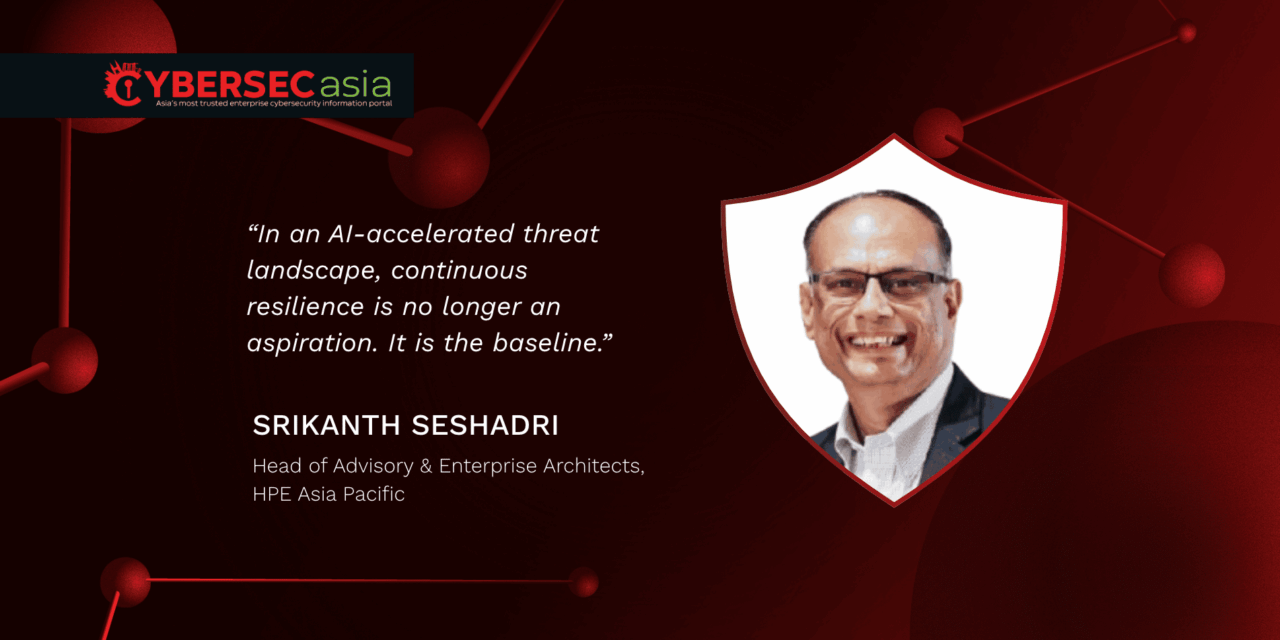
Srikanth Seshadri, Head of Advisory & Enterprise Architects, HPE Asia Pacific
More spending, but not more security
The investment case is not in doubt. IDC forecasts that total security spending in Asia Pacific excluding Japan (APeJ) will reach US$39.5 billion in 2026, growing at a 10% compound annual rate to US$52.4 billion by 2029 (IDC, “The New Cyber Trinity: Humans, AI Agents, and Trust in Asia/Pacific”).
IDC reads that growth as more than a response to rising threat volumes; it describes a structural shift in how trust must be built and governed in an AI-driven world.
Srikanth Seshadri is blunt about what the money has and has not bought. “Cybersecurity is entering a new phase, but enterprise security is struggling to keep pace,” he said. “Organizations are investing heavily in security, yet many continue to operate with fragmented tools and reactive defenses.”
IDC’s data shows what that looks like in practice. Its 2025 Future Enterprise Resiliency & Spending study found that 49% of APeJ enterprises have paid at least US$10,000 in ransom after a ransomware breach, and that adversaries are using AI to build synthetic identities that undermine authentication systems. Srikanth’s conclusion follows directly: “Yet spending alone is not translating into stronger security outcomes, even as the threat landscape becomes more challenging.”
Faster attacks, wider surfaces
Two forces are widening that execution gap. The first is speed. “AI-generated, hyper-personalized attacks can be created and adapted at a speed that traditional, reactive security models struggle to match,” Srikanth observed. The second is sprawl: “users, devices, and workloads are increasingly distributed across networks, cloud, and edge environments, making consistent security enforcement more difficult.”
NIST reached a similar diagnosis when it set out its Zero Trust Architecture guidance. It describes zero trust as a response to enterprise network trends that include remote users, bring-your-own-device and cloud-based assets that sit outside an enterprise-owned network boundary (NIST SP 800-207, Zero Trust Architecture). When the perimeter no longer marks where the enterprise ends, controls tied to that perimeter cannot deliver consistent protection.
IDC adds that the human side of the equation is under strain. Its research points to skills shortages and exploding telemetry volumes overwhelming traditional security operations centers, and to governments tightening controls on data and AI systems, with only 7% of enterprises highly prepared in terms of governance, risk and compliance skills.
Zero Trust as an operating principle
For Srikanth, the response starts with how Zero Trust is understood. “This makes Zero Trust more than a security framework,” he argued. “It needs to become an operational principle built into the infrastructure.”
In practice, he said: “Organizations must continuously validate access, enforce policy, and respond to changing risks across environments, rather than relying on implicit trust or isolated security controls.”
Connecting intelligence to the infrastructure
If Zero Trust is the principle, intelligence and enforcement are the mechanisms. “The next step is connecting security intelligence with the infrastructure where threats emerge,” Srikanth said.
He pointed to two capabilities in particular: “AI-native threat intelligence can help identify patterns and accelerate response, while cloud-based Zero Trust network access can enable consistent policy enforcement across distributed environments.”
The market is already moving in this direction. IDC reports that security operations centers are evolving from human-centric environments to AI-augmented and increasingly autonomous operations, with AI agents deployed to triage alerts, reduce false positives and orchestrate remediation at machine speed. Its Asia Pacific Security Study 2025 found that 39% of enterprises plan to apply AI or generative AI solutions in the next 12 months to improve threat detection and analysis (IDC).
The destination, in Srikanth’s words, is “a security architecture that continuously adapts to risk,” one that moves organizations “from fragmented controls” toward a connected, adaptive whole.
Turning awareness into action
None of this diminishes the value of awareness. As Seshadri put it: “Awareness remains important, but it alone cannot keep pace with an AI-accelerated threat landscape.”
IDC made the same point from the research side: security and trust “are no longer reactive controls,” but engineered, governed and continuously validated capabilities that determine enterprise resilience.
That reframes how leaders should judge their own progress. “The real measure of cybersecurity maturity is how quickly an organization can turn awareness into action,” Srikanth said.
Practical questions follow: How quickly can access be revoked when risk changes? Is policy enforced the same way in the data center, the cloud and the edge? Do security teams see threats where they emerge, or after they have spread?
The lesson from the region’s rising security budgets is that money is necessary but not sufficient. What separates resilient organizations from the rest is design: security that is, in Srikanth’s words, “continuous, intelligent, and built in by design, with Zero Trust as the foundation rather than another initiative layered onto the business.”
In an AI-accelerated threat landscape, continuous resilience is no longer an aspiration. It is the baseline.