
Top cybersecurity priorities for organisations transiting into the ‘agentic enterprise’ era.
Agentic AI is rapidly changing the balance of power in cybersecurity. As autonomous systems become more capable, attackers can move faster, scale their efforts and exploit vulnerabilities with less human intervention.
For Cory Minton, Global Field CTO, Splunk, the answer is not simply more automation, but a new security operating model: equip defenders with purpose-built agents, turn agent behavior into an observable security signal, and preserve human judgment at the moments that matter most.
His perspective centers on four priorities for organisations preparing to secure the emerging agentic enterprise, culled from an interview at Splunk’s .conf26 in Denver, Colorado in September 2026:

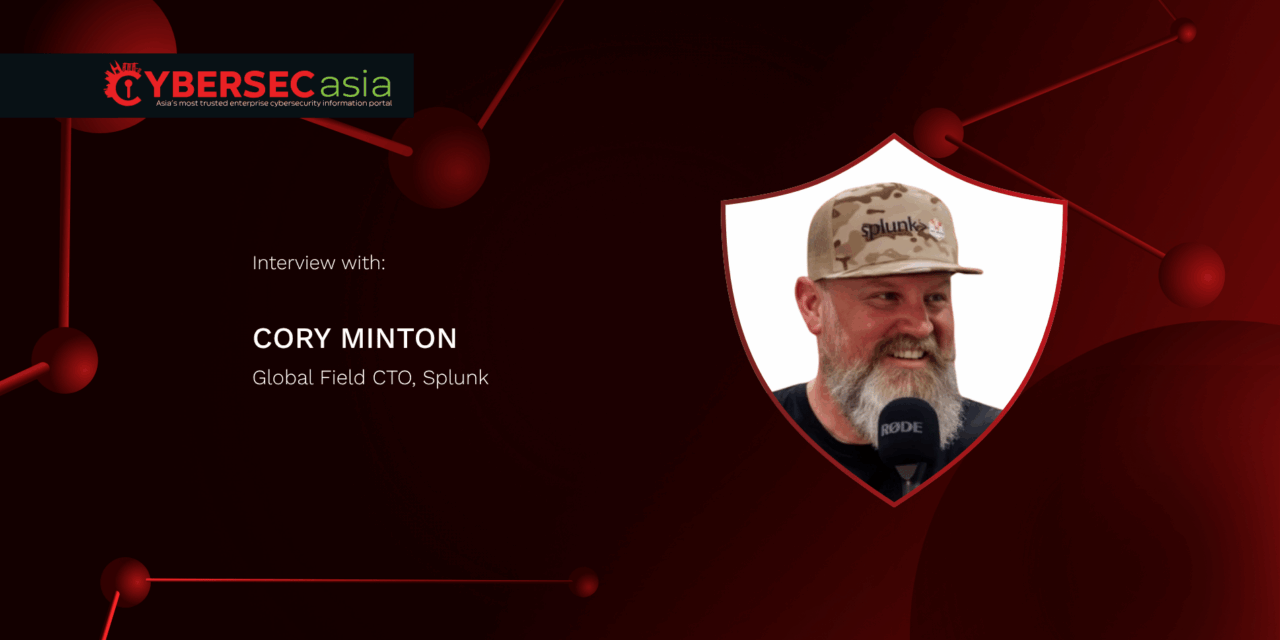
Cory Minton, Global Field CTO, Splunk
1. Attackers will use autonomous AI — defenders must match at machine speed
Minton expects attackers to become more capable, autonomous and AI-augmented, forcing defenders to operate at the same speed.
“Attackers are going to get better. Attackers are going to get more advanced. They are going to be more autonomous. So how do we defend at machine speed?”
His answer is to put comparable AI capabilities in defenders’ hands — using them to instrument environments, identify vulnerabilities and shorten the window between exposure and remediation:
“We need to put the same kinds of tools that are being used to build the attacks… to defend, so that enterprises can close the gap between vulnerabilities being exposed and stop them from being exploited as rapidly as possible.”
2. Agents as co-workers for security analysts, not replacements
Minton sees agents as co-workers that absorb routine work and reduce alert fatigue, especially for Tier 1 analysts — not as replacements for human judgment.
“The job of a tier one analyst is hard. It is hard dealing with the amount of alerts that get spun up, with the growing amount of incidents. How do we provide you with a capability to, say, remove a bunch of those alerts from your queue by allowing agents to help you remediate those [incidents] in an autonomous fashion?”
The goal is to deploy fit-for-purpose agents that:
- Autonomously remediate a slice of routine alerts.
- Pre-aggregate and explain why something matters.
- Present likely remediation paths but keep humans in the loop.
For escalated cases, the agent should be able to prepare the evidence and a recommended response. The agent can “bring informed delivery of ‘this is the why something has been predicted, and this is the likely remediation path’, and allow the human to decide.”
3. Agent observability as security signals
Agent observability telemetry can serve as both operational data and new security signals. It can reveal patterns in how agents behave and expose suspicious use: “All of that telemetry about what those agents are doing… the behavioral patterns… are really interesting security signals to understand if somebody’s trying to attack or exfiltrate data inappropriately.”
These signals should help teams detect misuse and exfiltration while testing whether agents are safe and compliant. Some questions Minton believes we should be asking include:
- How do I stop agents from doing inappropriate things?
- How do I detect when the agents are calling tools they shouldn’t be calling, calling access to data they shouldn’t have access to, or hallucinating the response?
- Are agents protected from the world, and are we protecting our world from our agents?
4. Human-in-the-loop, system of record for the “agentic enterprise”
Minton positioned Splunk as the system of record and intelligence for the “agentic enterprise” — the data and observability layer that coordinates agents while preserving human oversight.
His mission is to answer these questions: “How do we provide the power of Splunk as a system of record for the agentic enterprise? How do we make it possible for organisations to deploy machine speed prediction, machine speed detection, engage the agents at the right time, but keep humans in the loop?”
In this model, security depends on two capabilities working together:
- Agents that operate at machine speed.
- A data and observability fabric that lets humans supervise, constrain and direct those agents.
Ultimately, securing the agentic enterprise will require more than deploying faster tools. Organisations must pair machine-speed detection and response with clear visibility into how agents behave, ensure firm controls over what they can access and do, and human judgment for consequential decisions.
The advantage will go to defenders that treat AI agents not as unchecked replacements, but as observable, purpose-built partners operating within a trusted security framework.