
Cybersecurity News in Asia

RECENT STORIES:

SEGA moves faster with flow-based network monitoring
Survey indicates financial institutions already encountering agentic A...
Gambit Cyber Announces Strategic Partnership with BitCyber to Advance ...
Doppel Enters Japan, Marking Next Phase of Global Expansion
SU Group Announces Distribution Agreement with Germany’s GEZE, E...
Five years on, vulnerabilities can remain hidden in containerized soft...
LOGIN REGISTER
CybersecAsia
  • Features
    • Featured

      Are the built-in restrictions in Claude Fable 5 sufficient?

      Are the built-in restrictions in Claude Fable 5 sufficient?

      Friday, June 12, 2026, 8:52 AM Asia/Singapore | Features, Opinions
    • Featured

      Bringing cybercriminals to justice in APAC

      Bringing cybercriminals to justice in APAC

      Thursday, June 11, 2026, 10:30 AM Asia/Singapore | Features
    • Featured

      Cyber resilience – a national security imperative

      Cyber resilience – a national security imperative

      Wednesday, June 10, 2026, 3:09 PM Asia/Singapore | Features
  • Opinions
  • Tips
  • Whitepapers
  • AWARDS 2026
  • Directory
  • E-Learning

Select Page

NewsTips

Study: Cyber resilience in APAC foundational but not future-ready

By CybersecAsia editors | Friday, April 17, 2026, 9:30 AM Asia/Singapore

Study: Cyber resilience in APAC foundational but not future-ready

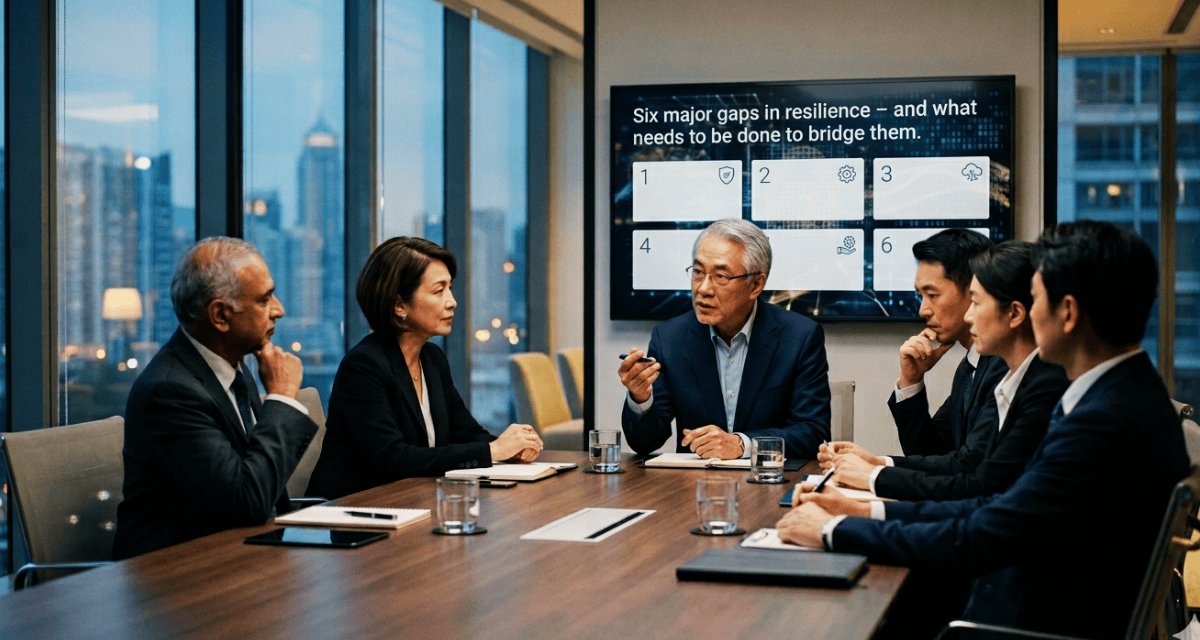
Six major gaps in resilience – and what need to be done to bridge them.

A new research report developed by EconomistImpact and supported by Telstra International, examines how organizations in APAC cope with technology disruptions, from cyber incidents to system failures, supplier outages, governance gaps, and decision‑making, particularly under real-world pressure.

The research is based on a survey of 1,420 senior executives across 11 APAC markets, with benchmarks from the United States, United Kingdom, and Germany.

Key findings from the report include:

  • Ecosystem resilience is the weakest link in digital resilience efforts
    APAC organizations are confident in their internal measures, such as training and testing, but confidence fades beyond their boundaries: only 12% have first-hand insight into suppliers’ resilience. 
    Limited information-sharing, infrequent joint simulations and weak partner governance make ecosystem interdependencies the main source of resilience failure. 
    Without active governance of key partners, disruptions spread easily, no matter how strong internal controls are. Such governance should include setting shared standards, conducting joint tests and ensuring clear visibility into third-party risks.
  • Workforce preparedness remains foundational rather than future-ready
    Resilience grows when planning and training focus on the ability to respond. Organizations must instil adaptive behaviors such as cross-functional co-ordination and under-pressure decision-making. The emphasis should be on how quickly teams can reorganize work when systems fail.
    Organizational gaps, not tools, derail incident response
    Organizations plan widely for responding to threats of digital disruption. But less than one-quarter (23%) of responses to real threats go according to plan. 
    Plans fail not due to a lack of technology, but because decision-making, co-ordination and authority structures break down in practice. Organizations cannot rely on technology investment alone to strengthen resilience.
  • Confidence is limited in external resilience enablers
    Executives express strong confidence in cybersecurity policy and planning (57%) but are far less assured in other external enablers of resilience, including the reliability of communications networks, regulatory clarity and the stability of power supply. 
    This uncertainty requires organizations to factor in redundancy and enable degraded-mode operations, across regions and cloud providers.
  • Risk management is largely reactive and monitoring is limited
    Most organizations have formal risk management frameworks, but these center mainly on cyber and IT risks. Attention to regulatory, supplier, geopolitical and climate risks is limited, and monitoring is periodic. 
    This leaves processes better suited to documenting known risks than to anticipating and managing fast-moving disruption. Continuous monitoring and forward-looking scenario-testing must become standard practice.
  • Senior leaders recognize digital resilience, but shared ownership remains limited 
    Senior-level responsibility for digital resilience tends to fall to one executive, such as the CIO. 
    At most organizations, boards are not heavily involved in review or planning of resilience-building efforts, which constrains strategic oversight and weakens enterprise-wide coordination.

Share:

PreviousPopular PC utility website served malware-laced installers for 19 hours
NextHighlights of Asia’s 2026 premier integrated security event

Related Posts

Thinking of boycotting Netflix for its stricter password sharing policy?

Thinking of boycotting Netflix for its stricter password sharing policy?

Thursday, May 25, 2023

Is your organization ready to defend surging AI-driven multichannel attacks this year?

Is your organization ready to defend surging AI-driven multichannel attacks this year?

Friday, February 6, 2026

The financial services industry should control GenAI risks, not fear them

The financial services industry should control GenAI risks, not fear them

Monday, February 24, 2025

Real estate logistics provider GLP steps up to zero trust architecture

Real estate logistics provider GLP steps up to zero trust architecture

Friday, April 19, 2024

Leave a reply Cancel reply

You must be logged in to post a comment.

Voters-draw/RCA-Sponsors

Slide
Slide
Slide
Slide
Slide
Slide
Slide
Slide
Slide
Slide
Slide
Slide
Slide
Slide
previous arrow
next arrow

CybersecAsia Voting Placement

Gamification listing or Participate Now

PARTICIPATE NOW

Vote Now -Placement(Google Ads)

Top-Sidebar-banner

Whitepapers

  • Closing the Gap in Email Security:How To Stop The 7 Most SinisterAI-Powered Phishing Threats

    Closing the Gap in Email Security:How To Stop The 7 Most SinisterAI-Powered Phishing Threats

    Insider threats continue to be a major cybersecurity risk in 2024. Explore more insights on …Download Whitepaper
  • 2024 Insider Threat Report: Trends, Challenges, and Solutions

    2024 Insider Threat Report: Trends, Challenges, and Solutions

    Insider threats continue to be a major cybersecurity risk in 2024. Explore more insights on …Download Whitepaper
  • AI-Powered Cyber Ops: Redefining Cloud Security for 2025

    AI-Powered Cyber Ops: Redefining Cloud Security for 2025

    The future of cybersecurity is a perfect storm: AI-driven attacks, cloud expansion, and the convergence …Download Whitepaper
  • Data Management in the Age of Cloud and AI

    Data Management in the Age of Cloud and AI

    In today’s Asia Pacific business environment, organizations are leaning on hybrid multi-cloud infrastructures and advanced …Download Whitepaper

Middle-sidebar-banner

Case Studies

  • How a Vietnamese D2C retailer built its own secure digital infrastructure

    How a Vietnamese D2C retailer built its own secure digital infrastructure

    Would your organization build your own digital infrastructure – including AI governance and cybersecurity – …Read more
  • Cyber protection for medical clinics in Singapore

    Cyber protection for medical clinics in Singapore

    As Singapore’s healthcare sector becomes increasingly digital and interconnected, clinics are facing heightened cyber risks, …Read more
  • India’s WazirX strengthens governance and digital asset security

    India’s WazirX strengthens governance and digital asset security

    Revamping its custody infrastructure using multi‑party computation tools has improved operational resilience and institutional‑grade safeguardsRead more
  • Bangladesh LGED modernizes communication while addressing data security concerns

    Bangladesh LGED modernizes communication while addressing data security concerns

    To meet emerging data localization/privacy regulations, the government engineering agency deploys a secure, unified digital …Read more

Bottom sidebar

Other News

  • Gambit Cyber Announces Strategic Partnership with BitCyber to Advance AI-Native and Risk-Centric Continuous Threat Exposure Management Across Singapore, ASEAN and Hong Kong

    Wednesday, June 17, 2026
    Strategic partnership brings Continuous Threat …Read More »
  • Doppel Enters Japan, Marking Next Phase of Global Expansion

    Tuesday, June 16, 2026
    Social engineering defense leader surpasses …Read More »
  • SU Group Announces Distribution Agreement with Germany’s GEZE, Expanding Smart Building and Safety Technology Portfolio

    Tuesday, June 16, 2026
    Agreement adds Globally Recognized Door, …Read More »
  • Hikvision Releases 2026 Cybersecurity White Paper, Fostering Digital Trust in the AIoT Era

    Friday, June 12, 2026
    HANGZHOU, China, June 12, 2026 …Read More »
  • Cohesity Gains Access to Anthropic’s Claude Mythos Preview Through Project Glasswing

    Tuesday, June 9, 2026
    Strengthening the Cohesity Data Cloud …Read More »
  • Our Brands
  • DigiconAsia
  • MartechAsia
  • Home
  • About Us
  • Contact Us
  • Sitemap
  • Privacy & Cookies
  • Terms of Use
  • Advertising & Reprint Policy
  • Media Kit
  • Subscribe
  • Manage Subscriptions
  • Newsletter

Copyright © 2026 CybersecAsia All Rights Reserved.