
Cybersecurity News in Asia

RECENT STORIES:

SEGA moves faster with flow-based network monitoring
NEC Appoints New Managing Director to Drive Next Phase of Growth in Ma...
Researchers warn cloud-centric passkey system may expose new vulnerabi...
Dragos Appoints Kaori Nieda as Country Manager to Drive Expansion in J...
Did geopolitical tensions drive 130% surge in Gulf-targeted phishing, ...
Fake CAPTCHA challenges are weaponizing trust to spread malware across...
LOGIN REGISTER
CybersecAsia
  • Features
    • Featured

      Agentic AI: The next great productivity hack or the ultimate security nightmare of 2026?

      Agentic AI: The next great productivity hack or the ultimate security nightmare of 2026?

      Wednesday, March 18, 2026, 3:00 PM Asia/Singapore | Features, Newsletter
    • Featured

      Misconfigured AI: Hype or real threat to APAC Infrastructure?

      Misconfigured AI: Hype or real threat to APAC Infrastructure?

      Monday, March 16, 2026, 7:36 PM Asia/Singapore | Features, Tips
    • Featured

      Building trust in Asia’s financial sector with digital identity innovations

      Building trust in Asia’s financial sector with digital identity innovations

      Monday, March 16, 2026, 9:45 AM Asia/Singapore | Features, Newsletter
  • Opinions
  • Tips
  • Whitepapers
  • Awards 2025
  • Directory
  • E-Learning

Select Page

Data ProtectionOpinions

4 data management trends and predictions for 2026

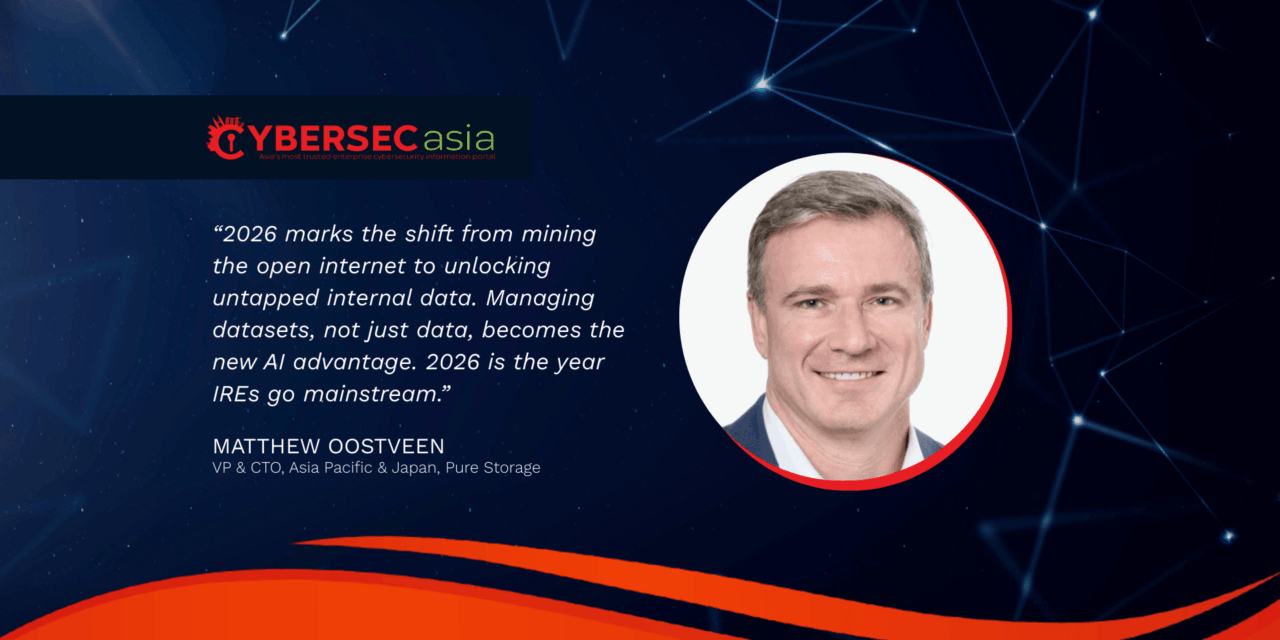
By Matthew Oostveen, VP & CTO, Asia Pacific & Japan, Pure Storage | Monday, December 22, 2025, 8:56 AM Asia/Singapore

4 data management trends and predictions for 2026

Shifts in AI models, dataset management, virtualization and isolated recovery environments will be some key developments in data management in the coming year.

By 2026, we’ll reach peak value from publicly available data, as AI models extract the last drops of signal from the open internet.

Enterprises will recognize that AI accuracy depends on data coherence. Virtualization will no longer be a product but an embedded capability, and several forces will converge to make isolated recovery environments (IREs) mainstream:

  1. AI models: 2026 marks the shift from mining the open internet to unlocking untapped internal data
    By 2026, we’ll reach peak value from publicly available data, as AI models extract the last drops of signal from the open internet. The next wave of AI progress will depend as much on discovering untapped data as on refining algorithms. Organizations will turn inward, racing to unlock data long trapped in legacy systems, mainframes, on-prem databases, and unstructured silos; though privacy and governance hurdles will slow progress.

    Synthetic data will emerge as a critical enabler, offering safe, scalable ways to train and test models without exposing sensitive information. Financial services will lead in simulations and risk modelling, while healthcare and other regulated sectors tread carefully. 2026 will mark an inflection point: a shift from mining what’s public to reimagining and reclaiming the hidden data within every organization.
  1. Managing datasets, not just data, becomes the new AI advantage
    Enterprises will recognize that AI accuracy depends on data coherence. Many large organizations still wrestle with multiple versions of truth; slightly different copies of the same data scattered across divisions and regions.

    In 2026, the focus will shift from collecting and cleaning data to governing datasets: curated, versioned, and contextual sources of truth that can be trusted across the business. Those who can eliminate fragmentation and maintain coherent, traceable datasets will see significant gains in model reliability and decision accuracy.

    In the era of enterprise AI, the true competitive edge won’t come from having more data—but from having consistent, managed datasets that everyone can trust.
  1. 2026: the virtualization revolt
    The decade-long dominance of proprietary hypervisors will finally fracture. While recent market consolidations have been a catalyst, the underlying drivers – cost, complexity, and the desire for greater control – have reached a breaking point. Enterprises across Asia Pacific, tired of rising license fees and shrinking flexibility, will begin rewriting their infrastructure playbooks.

    Virtualization will no longer be a product; it will be a capability, embedded natively into cloud, container, and edge platforms. Lightweight hypervisors, open-source technologies, and cloud-native orchestration will replace heavyweight virtual machine sprawl.

    The winners will be those who see this not as an exodus, but as an evolution: moving from managing virtual machines to virtualizing the entire stack – compute, storage, networks, and even AI workloads. By 2026, the infrastructure stack will become modular, programmable, and open. Vendor lock-in will give way to “infrastructure as code,” where the hypervisor quietly fades into the background.
  1. 2026: The year isolated recovery environments go mainstream
    In 2026, Isolated Recovery Environments (IREs) will move from a niche security measure to a boardroom mandate across Asia Pacific. As ransomware and destructive cyberattacks continue to escalate, organizations will recognize that traditional backups are no longer enough. The focus will shift from simply recovering data to assuring recovery itself, and secure isolation will become the new benchmark for cyber resilience.

    Several forces will converge to make IREs mainstream. Regulators will begin demanding demonstrable recovery integrity, insurers will link premiums to verifiable isolation, and boards who are still reeling from high-profile outages. They will push for architectural assurance rather than procedural promises. In response, enterprises will design recovery environments that are physically and logically segregated, automated, and continuously validated.

    Across APJ, IRE adoption will accelerate first in financial services, critical infrastructure, and manufacturing; sectors where downtime equals revenue loss or public risk. But the real shift will be cultural: IREs will redefine how organizations think about resilience, transforming backup from an operational afterthought into a core element of business continuity strategy.

Share:

PreviousAmid rapid digitalization and lagging cybersecurity oversight, India buckles up
NextAPAC cybersecurity outlook 2026: Quantum risks, API gaps, AI sovereignty, and cyber resilience

Related Posts

Are we smart enough for smart cities?

Are we smart enough for smart cities?

Friday, August 25, 2023

Nine cybersecurity trends to watch out for in 2021

Nine cybersecurity trends to watch out for in 2021

Tuesday, December 1, 2020

On Safer Internet Day, raise the alarm on fake news and deepfakes

On Safer Internet Day, raise the alarm on fake news and deepfakes

Tuesday, February 9, 2021

Remote-working risks: 6 security threats to be on guard for

Remote-working risks: 6 security threats to be on guard for

Tuesday, April 14, 2020

Leave a reply Cancel reply

You must be logged in to post a comment.

Voters-draw/RCA-Sponsors

Slide
Slide
Slide
Slide
Slide
Slide
Slide
Slide
Slide
Slide
Slide
Slide
Slide
Slide
previous arrow
next arrow

CybersecAsia Voting Placement

Gamification listing or Participate Now

PARTICIPATE NOW

Vote Now -Placement(Google Ads)

Top-Sidebar-banner

Whitepapers

  • Closing the Gap in Email Security:How To Stop The 7 Most SinisterAI-Powered Phishing Threats

    Closing the Gap in Email Security:How To Stop The 7 Most SinisterAI-Powered Phishing Threats

    Insider threats continue to be a major cybersecurity risk in 2024. Explore more insights on …Download Whitepaper
  • 2024 Insider Threat Report: Trends, Challenges, and Solutions

    2024 Insider Threat Report: Trends, Challenges, and Solutions

    Insider threats continue to be a major cybersecurity risk in 2024. Explore more insights on …Download Whitepaper
  • AI-Powered Cyber Ops: Redefining Cloud Security for 2025

    AI-Powered Cyber Ops: Redefining Cloud Security for 2025

    The future of cybersecurity is a perfect storm: AI-driven attacks, cloud expansion, and the convergence …Download Whitepaper
  • Data Management in the Age of Cloud and AI

    Data Management in the Age of Cloud and AI

    In today’s Asia Pacific business environment, organizations are leaning on hybrid multi-cloud infrastructures and advanced …Download Whitepaper

Middle-sidebar-banner

Case Studies

  • Cyber protection for medical clinics in Singapore

    Cyber protection for medical clinics in Singapore

    As Singapore’s healthcare sector becomes increasingly digital and interconnected, clinics are facing heightened cyber risks, …Read more
  • India’s WazirX strengthens governance and digital asset security

    India’s WazirX strengthens governance and digital asset security

    Revamping its custody infrastructure using multi‑party computation tools has improved operational resilience and institutional‑grade safeguardsRead more
  • Bangladesh LGED modernizes communication while addressing data security concerns

    Bangladesh LGED modernizes communication while addressing data security concerns

    To meet emerging data localization/privacy regulations, the government engineering agency deploys a secure, unified digital …Read more
  • What AI worries keep members of the Association of Certified Fraud Examiners sleepless?

    What AI worries keep members of the Association of Certified Fraud Examiners sleepless?

    This case study examines how many anti-fraud professionals reported feeling underprepared to counter rising AI-driven …Read more

Bottom sidebar

Other News

  • NEC Appoints New Managing Director to Drive Next Phase of Growth in Malaysia

    Thursday, April 2, 2026
    KUALA LUMPUR, Malaysia, April 1, …Read More »
  • Dragos Appoints Kaori Nieda as Country Manager to Drive Expansion in Japan

    Wednesday, April 1, 2026
    HANOVER, Md., April 1, 2026 …Read More »
  • Kingsoft Cloud Announces Unaudited Fourth Quarter and Fiscal Year 2025 Financial Results

    Wednesday, March 25, 2026
    BEIJING, March 25, 2026 /PRNewswire/ …Read More »
  • Inspira Enterprise Joins the Microsoft Intelligent Security Association

    Wednesday, March 25, 2026
    MUMBAI, India, March 24, 2026 …Read More »
  • Athena Intelligence Launches India Push Amid Rising Cross-Border Corporate Risk

    Tuesday, March 24, 2026
    Aditya Jain appointed to lead …Read More »
  • Our Brands
  • DigiconAsia
  • MartechAsia
  • Home
  • About Us
  • Contact Us
  • Sitemap
  • Privacy & Cookies
  • Terms of Use
  • Advertising & Reprint Policy
  • Media Kit
  • Subscribe
  • Manage Subscriptions
  • Newsletter

Copyright © 2026 CybersecAsia All Rights Reserved.