
Cybersecurity News in Asia

RECENT STORIES:

SEGA moves faster with flow-based network monitoring
API security gaps widen as Asia scales AI adoption
Recorded Future Announces Strategic Partnership with Wipro to Deliver ...
Dutch authorities dismantle botnet controlling 17m infected devices
As World Cup 2026 approaches, global agencies prepare fans for heighte...
How the financial services sector struggles with AI maturity despite d...
LOGIN REGISTER
CybersecAsia
  • Features
    • Featured

      Hidden trade-offs behind enterprise AI ambitions

      Hidden trade-offs behind enterprise AI ambitions

      Tuesday, May 26, 2026, 10:16 AM Asia/Singapore | Features
    • Featured

      Is secure issuance a solved problem, or is the debate more complex?

      Is secure issuance a solved problem, or is the debate more complex?

      Thursday, May 21, 2026, 3:11 PM Asia/Singapore | Features
    • Featured

      Cyber risk, fraud, and CX: Why banks can’t treat them separately anymore

      Cyber risk, fraud, and CX: Why banks can’t treat them separately anymore

      Wednesday, May 20, 2026, 9:34 AM Asia/Singapore | Features
  • Opinions
  • Tips
  • Whitepapers
  • AWARDS 2026
  • Directory
  • E-Learning

Select Page

Tips

API security gaps widen as Asia scales AI adoption

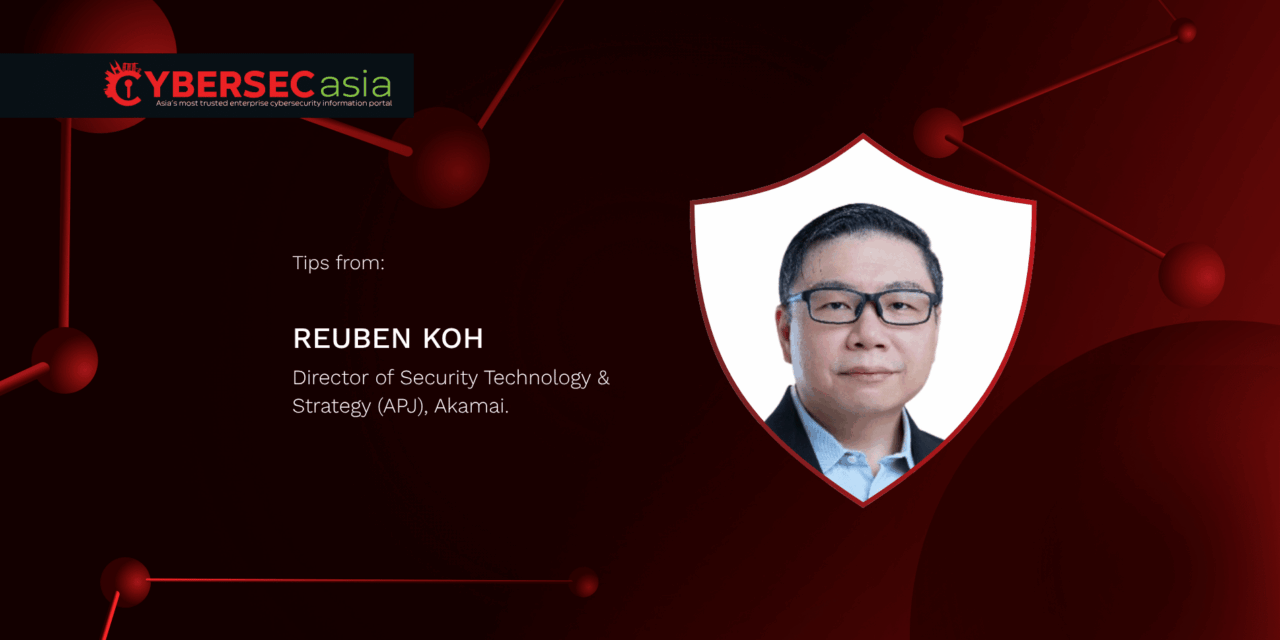
By Reuben Koh, Director of Security Technology & Strategy (APJ), Akamai | Wednesday, June 3, 2026, 11:35 AM Asia/Singapore

API security gaps widen as Asia scales AI adoption

Here are five foundational best practices for reducing risk, including earlier testing, endpoint visibility, bot differentiation and shared ownership.

Every AI assistant, chatbot, automation tool and autonomous agent relies on application programming interfaces (APIs) to access data, trigger actions and move information between systems.

As organizations in Asia race to deploy AI across payments, customer service, logistics and healthcare, APIs are becoming the connective tissue behind those services — and a growing security concern, according to Reuben Koh, Director of Security Technology & Strategy (APJ), Akamai.

The challenge is that API growth is often outpacing visibility. Many organizations do not have a full inventory of their endpoints, do not always know what normal traffic looks like and may struggle to distinguish legitimate use from abuse.

Koh said APIs are now so embedded in digital operations that organizations should treat them as critical infrastructure rather than back-end plumbing: “In the AI era, securing APIs means securing the business.”

He offers five established steps that organizations can take to reduce risk:

  1. Get full visibility into the API estate
    Koh said many exposures begin with endpoints teams do not know exist. “Much of the exposure comes not from sophisticated exploits, but from APIs that teams did not know existed,” he said. Shadow APIs and forgotten endpoints should be inventoried and monitored as part of routine security work.
  2. Move security earlier in the development cycle
    AI-assisted coding can speed up delivery, but it can also push vulnerable APIs into production too quickly. “If AI-assisted coding helps teams ship faster, security testing cannot remain a final-stage checkpoint,” Koh said. Security checks should happen during development and before deployment, not after release.
  3. Watch for abuse, not just breaches
    Attackers often use legitimate functions at scale instead of breaking in through obvious flaws. That means security teams should look for repeated requests, scraping, automated purchases or other abnormal behavior. “The bigger concern is how these attacks are evolving,” Koh noted.
  4. Separate helpful automation from harmful bots
    Not all automated traffic is bad. “Blocking all automated traffic is not the answer,” Koh said. Organizations need to distinguish between useful crawlers and malicious bots that scrape data, overwhelm services or mimic human behavior.
  5. Build shared ownership across teams
    API protection works best when developers, business teams and security teams operate from the same view of the environment, Koh added. “If these groups are not working from the same view of the API estate, attackers will find the seams.”

Koh also noted that the challenge is especially acute in Asia, where digital maturity varies widely across markets. In more mature markets, the issue is often scale and visibility. In faster-growing markets, the problem is speed: organizations are moving quickly to launch digital services, but security practices may not be keeping pace.

According to Koh, the core message is simple: API security is no longer a technical afterthought. A compromised API is not just a technical issue — it can create operational, financial and reputational damage. For organizations scaling AI, API security has to be part of the foundation, not an add-on after innovation is already underway.


Share:

PreviousRecorded Future Announces Strategic Partnership with Wipro to Deliver AI-Powered Threat Intelligence at Global Enterprise Scale

Related Posts

All we want for Christmas is to stay AI-scam-proof!

All we want for Christmas is to stay AI-scam-proof!

Tuesday, November 21, 2023

Who needs Halloween when cybercriminals go Trick-or-Treating all year round?

Who needs Halloween when cybercriminals go Trick-or-Treating all year round?

Wednesday, November 2, 2022

Balancing AI risks and cybersecurity resilience in Asia’s fragmented tech landscape

Balancing AI risks and cybersecurity resilience in Asia’s fragmented tech landscape

Monday, September 15, 2025

How to get everyone in the organization to be a risk management stakeholder

How to get everyone in the organization to be a risk management stakeholder

Monday, January 31, 2022

Leave a reply Cancel reply

You must be logged in to post a comment.

Voters-draw/RCA-Sponsors

Slide
Slide
Slide
Slide
Slide
Slide
Slide
Slide
Slide
Slide
Slide
Slide
Slide
Slide
previous arrow
next arrow

CybersecAsia Voting Placement

Gamification listing or Participate Now

PARTICIPATE NOW

Vote Now -Placement(Google Ads)

Top-Sidebar-banner

Whitepapers

  • Closing the Gap in Email Security:How To Stop The 7 Most SinisterAI-Powered Phishing Threats

    Closing the Gap in Email Security:How To Stop The 7 Most SinisterAI-Powered Phishing Threats

    Insider threats continue to be a major cybersecurity risk in 2024. Explore more insights on …Download Whitepaper
  • 2024 Insider Threat Report: Trends, Challenges, and Solutions

    2024 Insider Threat Report: Trends, Challenges, and Solutions

    Insider threats continue to be a major cybersecurity risk in 2024. Explore more insights on …Download Whitepaper
  • AI-Powered Cyber Ops: Redefining Cloud Security for 2025

    AI-Powered Cyber Ops: Redefining Cloud Security for 2025

    The future of cybersecurity is a perfect storm: AI-driven attacks, cloud expansion, and the convergence …Download Whitepaper
  • Data Management in the Age of Cloud and AI

    Data Management in the Age of Cloud and AI

    In today’s Asia Pacific business environment, organizations are leaning on hybrid multi-cloud infrastructures and advanced …Download Whitepaper

Middle-sidebar-banner

Case Studies

  • How a Vietnamese D2C retailer built its own secure digital infrastructure

    How a Vietnamese D2C retailer built its own secure digital infrastructure

    Would your organization build your own digital infrastructure – including AI governance and cybersecurity – …Read more
  • Cyber protection for medical clinics in Singapore

    Cyber protection for medical clinics in Singapore

    As Singapore’s healthcare sector becomes increasingly digital and interconnected, clinics are facing heightened cyber risks, …Read more
  • India’s WazirX strengthens governance and digital asset security

    India’s WazirX strengthens governance and digital asset security

    Revamping its custody infrastructure using multi‑party computation tools has improved operational resilience and institutional‑grade safeguardsRead more
  • Bangladesh LGED modernizes communication while addressing data security concerns

    Bangladesh LGED modernizes communication while addressing data security concerns

    To meet emerging data localization/privacy regulations, the government engineering agency deploys a secure, unified digital …Read more

Bottom sidebar

Other News

  • Recorded Future Announces Strategic Partnership with Wipro to Deliver AI-Powered Threat Intelligence at Global Enterprise Scale

    Wednesday, June 3, 2026
    Partnership to expand cybersecurity capabilities, …Read More »
  • Digital Identity Co. Modernizes Thailand Immigration Bureau Services with AWS

    Friday, May 29, 2026
    Mobile app enables travelers to …Read More »
  • VIVOTEK VORTEX Powers AI Cloud Security in Denmark’s Kongens Ege Mixed-Use Development

    Thursday, May 28, 2026
    TAIPEI, May 28, 2026 /PRNewswire/ …Read More »
  • DJI Releases Findings of the Most Comprehensive Independent Security Assessment of Its Drone Systems to Date

    Thursday, May 28, 2026
    Zero Critical, High, or Medium-Risk …Read More »
  • AUTOCRYPT Achieves WebTrust Accreditation for V2X PKI Infrastructure

    Tuesday, May 26, 2026
    SEOUL, South Korea, May 26, …Read More »
  • Our Brands
  • DigiconAsia
  • MartechAsia
  • Home
  • About Us
  • Contact Us
  • Sitemap
  • Privacy & Cookies
  • Terms of Use
  • Advertising & Reprint Policy
  • Media Kit
  • Subscribe
  • Manage Subscriptions
  • Newsletter

Copyright © 2026 CybersecAsia All Rights Reserved.