
Cybersecurity News in Asia

RECENT STORIES:

SEGA moves faster with flow-based network monitoring
When skyrocketing data flows erode traditional security boundaries, da...
EU age-verification app exposed as vulnerable within minutes after lau...
Akuvox X910 Claims Red Dot Award 2026: the World’s First AI-powe...
Exein establishes APAC headquarters and Taipei office
DNS‑record analysis shows uneven DMARC enforcement among FIFA World Cu...
LOGIN REGISTER
CybersecAsia
  • Features
    • Featured

      How AI is supercharging insider threats

      How AI is supercharging insider threats

      Wednesday, April 15, 2026, 12:29 PM Asia/Singapore | Features
    • Featured

      Q-Day is coming. Are you ready?

      Q-Day is coming. Are you ready?

      Tuesday, April 14, 2026, 12:40 PM Asia/Singapore | Features
    • Featured

      How lean defence teams turn endpoint insights into measurable risk reduction

      How lean defence teams turn endpoint insights into measurable risk reduction

      Monday, April 13, 2026, 3:15 PM Asia/Singapore | Features
  • Opinions
  • Tips
  • Whitepapers
  • Awards 2025
  • Directory
  • E-Learning

Select Page

Tips

When skyrocketing data flows erode traditional security boundaries, data lifecycle visibility becomes key

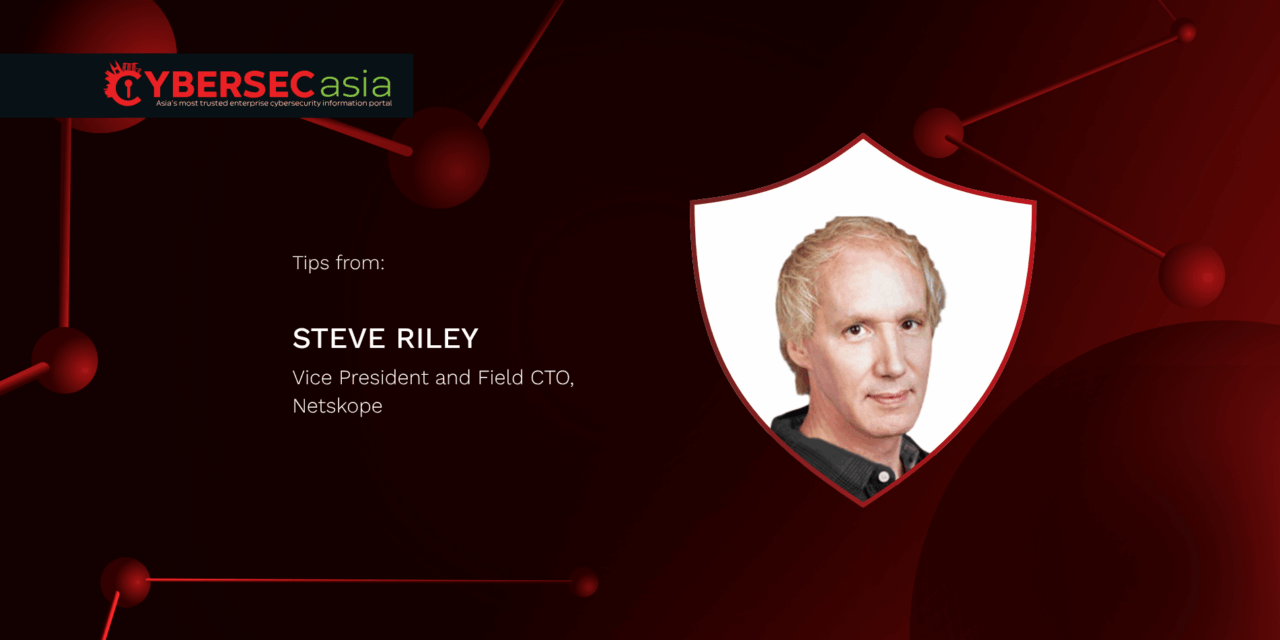
By Steve Riley, Vice President and Field CTO, Netskope | Tuesday, April 21, 2026, 4:45 PM Asia/Singapore

When skyrocketing data flows erode traditional security boundaries, data lifecycle visibility becomes key

Data lifecycle tracking links fragmented events across AI agents and cloud platforms, enabling compliance and threat reconstruction in complex environments.

In today’s regulatory environment, shaped by a growing patchwork of data protection laws across ASEAN — an inability to account for data movement is increasingly seen as a failure of governance, not just security.

For years, enterprise security has focused on controlling access at defined boundaries: essentially “watching the doors”. That model is under strain in the Asia Pacific region (APAC), where cloud adoption and digital transformation are accelerating post-pandemic. New applications and services continuously create new pathways for data movement, often outside traditional visibility.

As a result, the strategic focus is shifting from defending perimeters to protecting the data itself. While access controls remain necessary, they often struggle in the heterogeneous, multi-cloud, and legacy-heavy environments common across the region. Complexity and lack of interoperability limit their effectiveness.

Focusing on data movement as protection

Instead of focusing only on who can access data, an alternative approach, a longstanding concept called “data lineage”, focuses on tracking how data moves. It creates a continuous record of an object’s lifecycle — from origin to every subsequent transformation, transfer, and interaction. Importantly, this tracking persists even when data is copied, renamed, or reformatted — actions that typically break conventional metadata trails.

Consider a common insider-risk scenario: An employee exports a sensitive customer list from a customer relations management system, emails it externally, and the recipient modifies the file before uploading it to a personal storage platform:

  • Without lineage monitoring, these activities appear as separate, low-signal events: a download, an email, an upload. Each may fall below alert thresholds or be investigated in isolation.
  • With lineage, these actions are linked into a single narrative. The system retains the relationship between the original dataset and its derivatives, preserving context across transformations. This continuity allows defenders to reconstruct intent and sequence, accelerating root-cause analysis and enabling earlier intervention — even when attempts are made to obscure activity through file changes.

The result is not just better detection, but a clearer understanding of how data behaves within the organization.

Complicating data movements: AI agents

In the region’s rapidly evolving digital economies, data flows are no longer limited to human users. Automated processes, application programming interfaces and AI-driven agents now generate and move data at volumes that far exceed traditional oversight models.

This becomes particularly significant as organizations integrate large language models and other AI systems into their operations. Training data, in particular, introduces new risks: questions of provenance, consent, and regulatory compliance become harder to answer at scale. Embedding data lineage into these pipelines can provide a mechanism for enhanced traceability. It allows organizations to demonstrate where training data originated, how it was processed, and whether it complies with internal policies and external regulatory expectations. In emerging governance frameworks for AI, this kind of evidentiary trail is becoming increasingly important.

Integrating data lineage correctly

One of the challenges with data lineage methodology is that it cannot operate effectively in isolation. Tools that track data in a single domain — such as one cloud platform or application — fail to capture the full picture in environments where data constantly crosses boundaries.

To be useful, the framework needs to function as part of a broader, integrated security and data governance ecosystem. It must correlate signals across cloud software platforms, private applications, endpoints, and unmanaged environments, applying consistent policy regardless of where data resides or moves.

In APAC, where data is increasingly treated as a strategic and sovereign asset, this level of visibility is becoming a prerequisite for both security and compliance. Data naturally proliferates: copied, transformed, and redistributed in ways that are difficult to control. Data lineage does not stop that expansion, but it makes it observable.

By revealing the full story of how data is created, used, and shared, the paradigm enables organizations to balance two competing pressures: the need for rapid innovation and the requirement for accountability and control.


Share:

PreviousEU age-verification app exposed as vulnerable within minutes after launch

Related Posts

Data management and protection in the WFH multi-cloud era

Data management and protection in the WFH multi-cloud era

Friday, September 4, 2020

Are you hell-bent on living a reckless digital life with your smartphone?

Are you hell-bent on living a reckless digital life with your smartphone?

Thursday, August 17, 2023

Malicious trendjackers are cashing-in on DeepSeek: Tips for staying safe

Malicious trendjackers are cashing-in on DeepSeek: Tips for staying safe

Thursday, February 6, 2025

Tips: Operational Technology Attack Predictions

Tips: Operational Technology Attack Predictions

Tuesday, April 26, 2022

Leave a reply Cancel reply

You must be logged in to post a comment.

Voters-draw/RCA-Sponsors

Slide
Slide
Slide
Slide
Slide
Slide
Slide
Slide
Slide
Slide
Slide
Slide
Slide
Slide
previous arrow
next arrow

CybersecAsia Voting Placement

Gamification listing or Participate Now

PARTICIPATE NOW

Vote Now -Placement(Google Ads)

Top-Sidebar-banner

Whitepapers

  • Closing the Gap in Email Security:How To Stop The 7 Most SinisterAI-Powered Phishing Threats

    Closing the Gap in Email Security:How To Stop The 7 Most SinisterAI-Powered Phishing Threats

    Insider threats continue to be a major cybersecurity risk in 2024. Explore more insights on …Download Whitepaper
  • 2024 Insider Threat Report: Trends, Challenges, and Solutions

    2024 Insider Threat Report: Trends, Challenges, and Solutions

    Insider threats continue to be a major cybersecurity risk in 2024. Explore more insights on …Download Whitepaper
  • AI-Powered Cyber Ops: Redefining Cloud Security for 2025

    AI-Powered Cyber Ops: Redefining Cloud Security for 2025

    The future of cybersecurity is a perfect storm: AI-driven attacks, cloud expansion, and the convergence …Download Whitepaper
  • Data Management in the Age of Cloud and AI

    Data Management in the Age of Cloud and AI

    In today’s Asia Pacific business environment, organizations are leaning on hybrid multi-cloud infrastructures and advanced …Download Whitepaper

Middle-sidebar-banner

Case Studies

  • Cyber protection for medical clinics in Singapore

    Cyber protection for medical clinics in Singapore

    As Singapore’s healthcare sector becomes increasingly digital and interconnected, clinics are facing heightened cyber risks, …Read more
  • India’s WazirX strengthens governance and digital asset security

    India’s WazirX strengthens governance and digital asset security

    Revamping its custody infrastructure using multi‑party computation tools has improved operational resilience and institutional‑grade safeguardsRead more
  • Bangladesh LGED modernizes communication while addressing data security concerns

    Bangladesh LGED modernizes communication while addressing data security concerns

    To meet emerging data localization/privacy regulations, the government engineering agency deploys a secure, unified digital …Read more
  • What AI worries keep members of the Association of Certified Fraud Examiners sleepless?

    What AI worries keep members of the Association of Certified Fraud Examiners sleepless?

    This case study examines how many anti-fraud professionals reported feeling underprepared to counter rising AI-driven …Read more

Bottom sidebar

Other News

  • Akuvox X910 Claims Red Dot Award 2026: the World’s First AI-powered Parcel Detection Smart Intercom Revolutionizes Luxury Home Access

    Saturday, April 18, 2026
    XIAMEN, China, April 17, 2026 …Read More »
  • Exein establishes APAC headquarters and Taipei office

    Saturday, April 18, 2026
    Partnering with Taiwan’s ecosystem to …Read More »
  • Tsingke Unveils ‘Zero-Contact’ Gene Synthesis to Safeguard Core Genetic Sequences

    Wednesday, April 15, 2026
    BEIJING, April 15, 2026 /PRNewswire/ …Read More »
  • NEC Asia Pacific to Showcase Trusted Public Safety and Digital Identity Innovations at Milipol TechX 2026

    Wednesday, April 15, 2026
    SINGAPORE, April 14, 2026 /PRNewswire/ …Read More »
  • Sprinto Expands to Australia with New Data Center to Power Localized, Audit-Ready Compliance

    Wednesday, April 15, 2026
    Sprinto combines local infrastructure with …Read More »
  • Our Brands
  • DigiconAsia
  • MartechAsia
  • Home
  • About Us
  • Contact Us
  • Sitemap
  • Privacy & Cookies
  • Terms of Use
  • Advertising & Reprint Policy
  • Media Kit
  • Subscribe
  • Manage Subscriptions
  • Newsletter

Copyright © 2026 CybersecAsia All Rights Reserved.